

- Call our boiler installation team:
- 01261 394011
Please complete the form below with your details, and one of our team members will contact you.
Imagine waking up on a biting January morning in the Highlands only to find your radiators are stone cold and the shower won’t run hot. You check the cupboard and see that dreaded needle resting at zero. It’s a moment of pure frustration that many Scottish homeowners face every winter. You might be worried about the cost of a call-out or feel confused by the tangle of pipes and valves under the casing. Finding a permanent boiler losing pressure fix doesn’t have to be a source of anxiety. We understand that your priority is a warm home and a safe system without unnecessary expense.
This guide will help you understand exactly why your system is struggling and how to restore your heating safely. We’ll show you how to identify common leaks, explain how to use different filling loops, and clarify when it’s time to call a Gas Safe registered specialist. By the end of this article, you’ll know how to get your pressure back to its optimal level whilst ensuring you have the right protection in place to keep it there. We’ll help you stop the cycle of dropping pressure so you aren’t facing the same cold house this time next week.
Your boiler is the heart of your home, especially during those long Scottish winters. Most modern combi and system boilers are “sealed systems”, meaning they’re filled with a specific amount of water that stays at a constant pressure. It’s helpful to think of it like a car tyre; if the pressure isn’t right, the whole system fails to perform. A key part of this setup is the expansion vessel. This small tank contains a rubber diaphragm that absorbs the extra volume as water heats up and expands. It keeps everything in equilibrium and prevents pipes from bursting under stress.
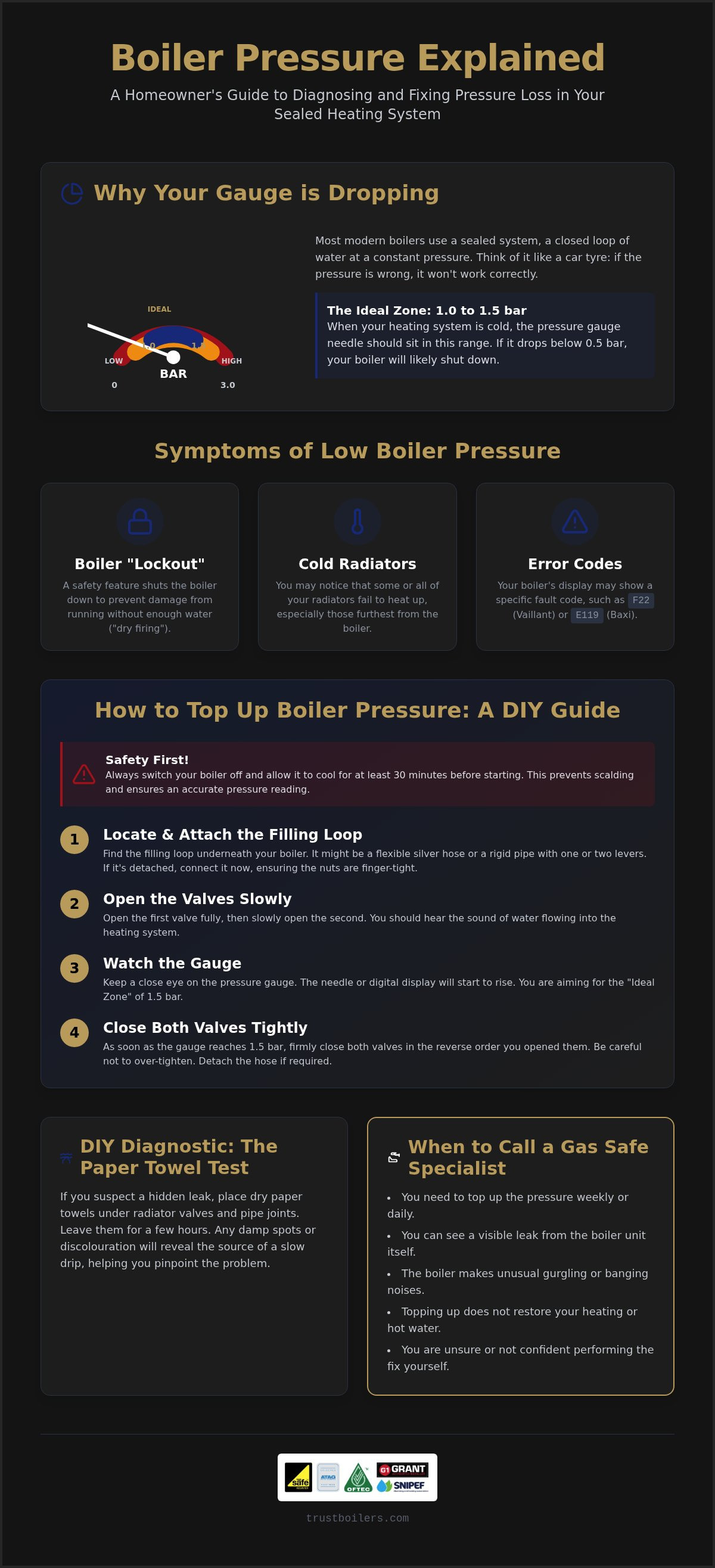
To keep an eye on this, you’ll need to check your gauge. Older models use a traditional needle dial, where the needle should ideally sit in the green section. Modern units often feature digital displays that show a precise “bar” reading. For a cold system, you’re aiming for the “Ideal Zone” between 1.0 and 1.5 bar. If the needle drops towards the red zone or the digital screen shows less than 0.5, you’ll likely need a boiler losing pressure fix to get things moving again.
How do you spot a drop before the house gets cold? The most common sign is a boiler “lockout”. This is a protective safety feature that shuts the unit down to prevent “dry firing”, which is when the boiler tries to heat up without enough water inside. It’s a clever way to protect expensive Boiler components and safety features from permanent damage. You might also notice radiators that are cold at the top or a specific error code on your display. Common codes to look out for include F22 on Vaillant models or E119 on Baxi systems. Both signify that the internal water pressure has fallen too low for the unit to operate safely.
It’s easy to panic when the heating goes off, but a drop isn’t always a sign of a major fault. A very small loss of pressure, around 0.1 bar per year, is considered normal for many systems. If you’ve recently spent an afternoon bleeding your radiators to get rid of air pockets, you’ve actually removed water from the system. This naturally causes the pressure to dip. It’s also common to see a drop when you first turn the heating on in autumn after a quiet summer. The water has cooled and contracted, sometimes falling just enough to trigger a lockout. In these cases, a simple top-up is often all that’s required to restore your peace of mind.
Before you reach for the valves, safety is your absolute priority. Whilst most modern systems are designed for homeowner adjustment, they fall under the broad remit of the Pressure Systems Safety Regulations, which underline the importance of maintaining equipment in a safe condition. Always ensure your boiler is switched off at the wall and the system has had at least 30 minutes to cool down. Handling a hot system increases the risk of scalding and can lead to inaccurate gauge readings as the water contracts.
Your specific boiler losing pressure fix depends entirely on the hardware installed. In many older Scottish homes, you’ll find an external braided hose. This is a flexible silver pipe that connects two separate copper pipes. In newer builds across Aberdeenshire and the Highlands, you might see a rigid copper loop instead. Some modern brands, like Worcester Bosch or Vaillant, use internal key-less links. These are often small blue or white levers tucked away behind a plastic flap on the underside of the boiler casing. Knowing which one you have prevents you from accidentally turning the wrong valve.
It’s vital to avoid the “Over-Pressurisation Trap”. If you fill the system beyond 2.0 bar whilst it’s cold, the pressure will likely soar into the red zone once the heating is active. This triggers the safety discharge pipe, which can lead to further leaks. If you find yourself needing to do this more than once a month, it’s a sign of an underlying issue. A professional boiler repair specialist can help identify if a component is failing before it leads to a total system breakdown.
If you’ve topped up your system only to find the needle continuing its downward slide, you’re likely looking for a more permanent boiler losing pressure fix. A leak doesn’t always announce itself with a puddle on the kitchen floor. In the dry, warm air of a heated home, small drips often evaporate from hot pipes before they ever hit the carpet. This is why a methodical search is the best way to protect your property from long-term dampness.
The “Paper Towel Test” is a simple but effective diagnostic tool. Take a piece of dry kitchen roll and wrap it tightly around every radiator valve, joint, and union in your home. Check back after an hour. Even a tiny “weep” that is invisible to the eye will leave a tell-tale damp patch on the paper. For our clients in rural Moray or the Highlands, oil boilers present a unique challenge. These systems often utilise external expansion vessels located in garages or outbuildings. Because these are exposed to colder temperatures, the diaphragms can perish more quickly than those in internal gas units, leading to steady pressure loss that is easily missed during a quick indoor inspection.
Sometimes the issue is tucked away inside the boiler casing itself. One common culprit is the Auto Air Vent (AAV). This component is designed to bleed air out of the system automatically, but it can develop a leak over time. You can often spot this by looking for green or white mineral deposits, known as “furring”, around the vent. You should also inspect the lockshield valves on the side of every radiator. These are the valves with the plastic caps that you don’t usually turn; if the internal gland nut has loosened, it will cause a slow, persistent drop in pressure that can baffle most homeowners.
Have you noticed a “Dancing Needle” on your gauge? If the pressure spikes rapidly toward 3.0 bar when the heating is on, then drops to zero once it cools, your expansion vessel has likely lost its air charge. When this vessel fails, the water has nowhere to expand, forcing the Pressure Relief Valve (PRV) to open. You can test this by checking the small copper pipe on your outside wall. If it is dripping or shows signs of water staining, the PRV is likely stuck open or has been triggered by an over-pressurised system. Because these repairs involve internal safety components, they require a professional boiler engineer to ensure the system is recharged and sealed correctly.
Have you been told that topping up your system once a week is just part of owning a boiler? This is one of the most damaging myths in home maintenance. Whilst it might seem like a quick boiler losing pressure fix, you’re actually inviting a silent killer into your heating system. Every time you open that filling loop, you introduce fresh, oxygenated water. In a sealed system, oxygen is quickly consumed; by constantly refreshing it, you provide the fuel for internal corrosion. This process creates magnetite, a black metallic sludge that settles in your radiators and chokes your pump.
Some homeowners turn to “Stop Leak” chemicals as a cheap sticking plaster. We strongly advise against this. These sealants are often non-discriminatory; they don’t just find the leak, they can also gum up the delicate sensors and the narrow channels of your heat exchanger. It’s a temporary gamble that often leads to a much larger repair bill down the line.
Every litre of fresh water you add dilutes the protective inhibitor chemicals that were added during your last service. Without this protection, your radiators begin to rust from the inside out. This is particularly relevant for our clients in Aberdeen. Our local water is naturally soft, which many people think is a benefit. However, soft water can be surprisingly aggressive towards copper and brass components if the chemical balance isn’t maintained. Over time, this “hungry” water eats away at your boiler’s internal seals, leading to the very leaks you’re trying to ignore. The cumulative cost of replacing rusted radiators and a failed pump far outweighs the price of a one-time professional repair.
There’s a clear line between a minor adjustment and a systemic failure. If your pressure drops back to zero within 24 hours of a top-up, you no longer have a “small leak”. You have a significant fault that requires immediate attention. A persistent drop can also be a symptom of a cracked heat exchanger. This is the heart of your boiler, and if it’s leaking internally, the water often escapes out of the condensate pipe, making the leak invisible to the naked eye.
Don’t wait for a total lockout in the middle of a cold snap. Investing in a boiler care plan in Aberdeenshire is the best way to catch these issues before they cause permanent damage. If you’re tired of checking your gauge every morning, booking a professional boiler repair is the only way to ensure your heating remains reliable and efficient all year round.
How do you stop the cycle of checking your boiler cupboard every morning? While the immediate boiler losing pressure fix might involve a manual top-up, the true solution lies in preventing the drop from occurring in the first place. Long-term reliability is built on proactive maintenance rather than reactive repairs. In the harsh coastal climates of Peterhead and Fraserburgh, your heating system works harder than most, making preventative measures even more critical for your peace of mind.
An annual service is your first line of defence. During this visit, a specialist will check the air charge in your expansion vessel, ensuring it can still handle the pressure spikes we discussed earlier. We also recommend installing a magnetic system filter. This device acts as a guardian for your boiler, capturing the metallic sludge and magnetite before they can damage sensitive internal seals or the pump. For homeowners looking for complete control, upgrading to modern smart controls allows you to monitor your system’s health remotely, often alerting you to a pressure drop before the house even begins to cool.
Choosing a professional care plan moves you from the stress of emergency call-outs to the comfort of planned protection. If you experience a pressure failure during the peak of a Scottish winter, our care plan members receive priority attention to get the heating back on. These plans include annual safety checks that catch those tiny, hidden “weeps” on radiator valves before they can cause expensive floor damage or structural dampness. This stability is especially valuable for rural homes that rely on oil boilers or air source heat pumps, where system reliability is the only thing standing between you and the winter chill.
Don’t wait for the first frost to find out your system is struggling. Summer is the optimal time to organise a full system flush and an inhibitor top-up. This clears out any existing debris and reinforces the chemical barrier against corrosion. Before the cold weather truly settles in, you can perform a quick check to ensure everything is in order:
If you’re unsure about the health of your system, our local team in Aberdeen is ready to help. We provide comprehensive health checks across Buckie, Elgin, and the surrounding Highlands, ensuring your home stays warm and your boiler stays protected for the long haul.
Maintaining a warm home during a long Scottish winter requires more than just a quick top-up. We’ve seen how pressure loss is often a signal from your system that a component needs attention; whether it’s a hidden leak or a failing expansion vessel. Remember that whilst a manual adjustment offers a temporary boiler losing pressure fix, the long-term health of your heating depends on keeping oxygen and sludge at bay. By addressing these issues now, you protect your radiators from internal corrosion and ensure your system operates at peak efficiency.
If you’re tired of second-guessing your gauge or worrying about a cold morning lockout, our team is here to provide a permanent solution. As Gas Safe and OFTEC registered specialists with over 100+ 5-star local reviews, we support homeowners across Fraserburgh, Aberdeen, and the Highlands with expert care. We believe in doing the job correctly the first time to give you lasting peace of mind. Book a Professional Boiler Repair in Aberdeenshire today and let us take the stress out of your home maintenance. You can look forward to a warm, reliable home all season long.
You should avoid running your system if the pressure is critically low. Most modern units in Aberdeen or Elgin will trigger a safety lockout when the gauge drops below 0.5 bar. This prevents dry firing, which can cause severe damage to your internal components. If your boiler is still running but the needle is low, it will be working inefficiently and could lead to a more expensive repair if left unaddressed.
You should only need to top up your system once or twice a year, typically after you have bled your radiators. If you find yourself searching for a boiler losing pressure fix every few weeks, there is an underlying issue that needs professional attention. Constant topping up introduces fresh oxygen and minerals into the pipes, which accelerates internal corrosion and creates sludge buildup in your heat exchanger.
Over-pressurising your boiler can lead to the safety discharge pipe being triggered. If the needle enters the red zone, usually above 3.0 bar, the system will attempt to vent excess water to protect your pipework. This can sometimes cause the valve to get stuck in the open position, leading to a persistent leak. You can usually lower the pressure by carefully bleeding a radiator until the gauge returns to 1.5 bar.
It is normal for pressure to rise slightly as water expands when it heats up. A small increase of 0.3 to 0.5 bar is expected. However, if the needle jumps significantly or hits the red zone, your expansion vessel has likely lost its air charge. This is a common issue we see in the Highlands and Moray, requiring an engineer to recharge or replace the vessel to restore the system’s equilibrium.
Not necessarily, as most pressure issues are caused by replaceable parts like valves or expansion vessels. However, if your boiler is over ten years old and experiencing frequent leaks or internal failures, a new installation might be more cost-effective than constant repairs. Our local team can assess your system in Peterhead or Fraserburgh to help you decide between a professional repair or a modern, high-efficiency replacement.
Yes, even a tiny “weep” from a radiator valve can cause a steady drop in pressure over time. Because heating systems are sealed, any loss of water anywhere in the circuit will reflect on the boiler’s gauge. We often find that loose gland nuts on radiator valves are the culprit. If you spot dampness or mineral deposits around your radiator joints, tightening these connections is often the simplest boiler losing pressure fix.
The cost depends entirely on the location and severity of the leak. A simple fix, such as replacing a radiator valve or a pressure relief valve, is relatively straightforward. More complex issues involving internal boiler components or underfloor pipework will naturally require more time and parts. Whilst we don’t provide fixed quotes without an inspection, our local engineers across Aberdeenshire prioritise transparent pricing and long-term reliability over quick, temporary patches.
If there are no visible puddles, the leak is likely internal or hidden from view. The water could be escaping through the condensate pipe or the external pressure relief pipe on your outside wall. In some cases, the expansion vessel may have failed completely, or there could be a leak in pipework hidden under floorboards. Our specialists in Huntly and Keith use diagnostic tools to locate these hidden faults without causing disruption.
FREE Download

Please complete the form below with your details, and one of our team members will contact you.
