

- Call our boiler installation team:
- 01261 394011
Please complete the form below with your details, and one of our team members will contact you.
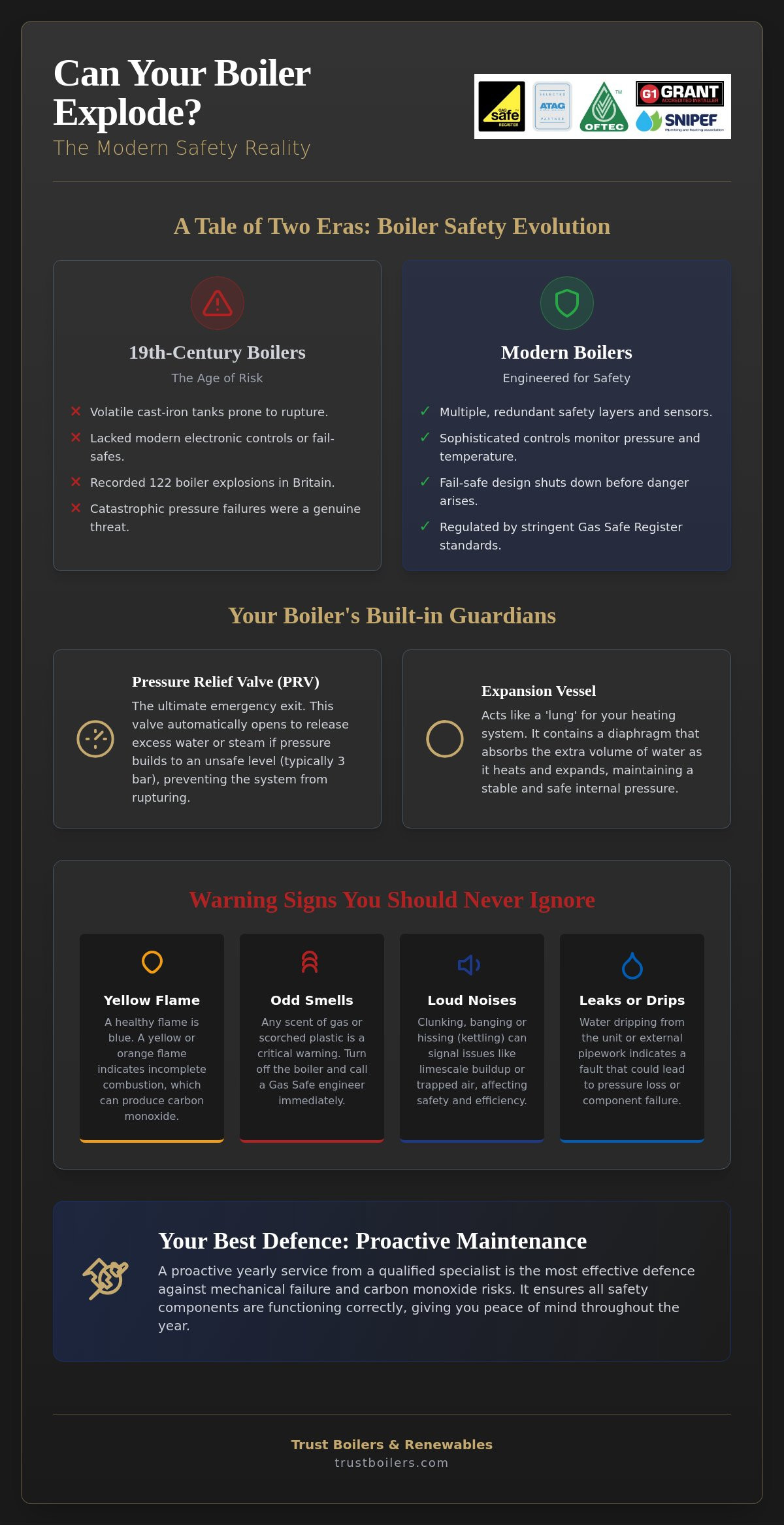
Did you know that whilst there were 122 recorded boiler explosions in 19th-century Britain, modern engineering has made such events incredibly rare today? It’s completely natural to feel a flicker of worry when your heating system starts making a strange clunking sound or if you’re relying on an older unit. You want to protect your home, and the fear of a catastrophic accident can be genuinely stressful. Many homeowners find themselves asking can a boiler explode after hearing an unusual hiss or bang from the airing cupboard.
The reality is that your boiler is equipped with multiple, redundant safety layers designed to shut the system down long before any danger arises. We’ll show you exactly how these safety valves work and provide a clear checklist of the warning signs that truly require a professional’s eye. This guide offers the reassurance you need by explaining the technology that keeps you safe and the simple maintenance steps that act as your primary line of defence. By understanding what is happening inside the unit, you can replace fear with the peace of mind that comes from expert knowledge.
If you’ve ever felt a pang of anxiety whilst standing near your utility cupboard, you aren’t alone. The question of whether a boiler explosion is a genuine threat in 2026 is one we hear often. Whilst the short answer is technically “yes”, the practical reality is that modern engineering has made such events incredibly rare in the UK. Stringent regulations and the oversight of the Gas Safe Register have transformed these appliances from the volatile cast-iron tanks of the past into highly controlled, sophisticated machines. In fact, you’re statistically far more likely to experience a minor electrical fault than a catastrophic mechanical failure.
The safety landscape has shifted dramatically since the mid-20th century. Older units lacked the complex electronic “brains” that modern combi and system boilers rely on today. When homeowners ask can a boiler explode, they are often remembering stories of older systems that didn’t have the redundant fail-safes we now take for granted. Today, every installation must meet rigorous standards, ensuring that even if one component fails, several others are waiting to step in and shut the system down safely.
In the 19th century, boiler failures were a frequent and deadly occurrence. However, as design evolved from the 1970s onwards, the focus shifted toward preventative safety. Most modern “boiler explosions” reported in the news are actually gas leak ignitions rather than a failure of the boiler’s pressure vessel itself. Design improvements, such as the move from heavy cast-iron heat exchangers to lightweight stainless steel or aluminium, mean that modern units simply don’t have the same capacity to build up lethal levels of pressure without triggering a safety shutdown. Data from the Gas Safe Register suggests that the vast majority of dangerous incidents are linked to illegal installations or a total lack of professional maintenance rather than inherent design flaws.
It’s helpful to distinguish between two very different types of failure. A pressure-related incident occurs when water expands into steam without a way to escape. If the pressure exceeds the physical strength of the tank, it can rupture. Modern engineering prevents this through the Pressure Relief Valve, which acts as a dedicated emergency exit for excess steam. On the other hand, a gas explosion is the result of fuel escaping into the room and finding an ignition source. Both risks are effectively neutralised by modern sensors that cut off the fuel supply if a flame isn’t detected or if internal temperatures spike too quickly. Your boiler is designed to be a “proactive guardian”, choosing to stop working entirely rather than operating in an unsafe state.
Understanding the internal mechanics of your heating system can turn a source of anxiety into a source of confidence. Whilst the question can a boiler explode is grounded in the physics of high-pressure steam, modern boilers are designed to fail “safe”. This means that if a component stops working, the system is engineered to shut down entirely rather than continue operating in a hazardous condition. Your boiler manages this through a series of redundant systems that monitor pressure, temperature, and fuel flow every second it’s running.
At the heart of this protection is the expansion vessel. Think of this as a “lung” for your heating system. As water heats up, it naturally expands. Without an expansion vessel to absorb this extra volume, the internal pressure would rise rapidly. By managing these natural physical changes, the boiler maintains a steady, safe environment. If these primary controls were ever to be overwhelmed, the secondary defences would immediately take charge.
The Pressure Relief Valve is your boiler’s ultimate emergency exit. Typically set to trigger at 3 bar of pressure, this mechanical spring-valve opens to let water or steam escape before the internal components reach their breaking point. You can often see the evidence of this system on your external wall. It’s the small, curved copper pipe that points back toward the brickwork. If you notice this pipe is dripping, it’s actually a sign that the safety system is doing its job by venting excess pressure. Whilst a drip might indicate that your expansion vessel needs a recharge, it proves that the fail-safe is active and protective. To ensure these valves remain in peak condition, regular boiler servicing is essential for every household.
Gas safety is managed by a sophisticated process called flame supervision. Inside the combustion chamber, a small component known as an ionisation probe or thermocouple acts as a constant monitor. It looks for the physical presence of a flame. If the flame goes out for any reason, the probe detects the drop in temperature or electrical current and signals the gas solenoid to snap shut. This happens in a fraction of a second. It’s physically impossible for gas to continue pouring into your home if there’s no flame to burn it.
This redundancy is why actual gas-related incidents are almost exclusively linked to improper DIY attempts on the gas valve itself. Modern valves are factory-sealed and designed to be tamper-proof, ensuring that the fuel stays exactly where it belongs. Finally, the overheat thermostat acts as the system’s “kill switch”. If the water temperature spikes beyond a safe limit, perhaps due to a pump failure, this thermostat breaks the electrical circuit to the gas valve. The fire goes out instantly. By layering these mechanical and electronic defences, your boiler remains a reliable guardian of your home’s comfort.
Have you noticed your heating system behaving strangely lately? It is often the subtle changes, such as a faint scent in the air or a new vibration behind the cupboard door, that signal a need for professional intervention. Whilst we have explored why modern engineering means you don’t need to lie awake wondering can a boiler explode, you should never ignore the physical cues your system provides. According to data from the Gas Safe Register, 57% of engineers found a dangerous gas appliance in a customer’s home over the past year. Most of these issues were discovered because the homeowner noticed something “off” and took action.
The most immediate red flag is a pressure gauge that consistently sits in the “red” zone, typically above 3 bar. As we discussed regarding the Pressure Relief Valve, your boiler has ways to vent this, but a constant high-pressure state suggests the primary safety controls are struggling. Similarly, keep a watchful eye for sooty marks, staining, or discolouration on the boiler’s outer casing. These marks, often accompanied by a yellow or orange flame instead of a crisp blue one, are classic indicators of incomplete combustion and the potential presence of carbon monoxide.
Does your boiler sound like a whistling kettle? This phenomenon, known as “kettling”, occurs when limescale or sludge builds up on the heat exchanger. This debris restricts water flow, causing the water trapped inside to reach boiling point and turn to steam almost instantly. Whilst some sources claim kettling is a sign of an imminent explosion, in a modern UK home, it is far more likely to trigger a safety “lockout” where the system simply refuses to fire up. However, the internal stress caused by this “water hammer” effect can damage valves and seals over time. If your pipes are banging or the unit is vibrating excessively, the system is working far harder than it should, which compromises both safety and efficiency.
Your sense of smell is a powerful diagnostic tool. If you detect a scent reminiscent of rotten eggs, this is likely mercaptan, an additive put into natural gas to help you identify leaks. If you smell it, you must turn off your gas supply and contact a professional immediately. Different but equally concerning is the smell of spent matches or scorched plastic. This often points to electrical components overheating or a breach in the combustion seal. Finally, if your pilot light frequently goes out or the flame appears “lazy” and yellow, the burner is not receiving the correct air-to-fuel ratio. These aren’t just minor inconveniences; they are the proactive warnings your boiler sends before a component fails completely.
One of the most critical safety features unique to oil installations is the remote-acting fire valve. This is a mechanical device installed on the oil supply line, typically outside the property where the pipe enters the building. If the valve detects extreme heat or a fire at the boiler, it snaps shut instantly. This cuts off the fuel supply from your external storage tank, preventing a small burner fault from escalating into a major incident. It’s a simple, reliable piece of engineering that provides an essential layer of protection for remote properties.
Have you ever heard a sudden, muffled “boom” when your oil burner starts up? This is often caused by delayed ignition. It happens when a fine mist of oil vapour builds up in the combustion chamber before the spark ignites it. When it finally catches, the sudden combustion of that pooled vapour creates a small pressure wave. Whilst this isn’t the catastrophic failure people imagine when they ask can a boiler explode, it can damage the internal baffles and flue over time. These events are usually caused by a worn burner nozzle or faulty electrodes. Because our climate in Northern Scotland is so demanding, having a local OFTEC-registered specialist to calibrate your burner is vital for preventing these unnerving start-up noises.
The Scottish winter is a formidable opponent for any heating system. In places like Elgin or Peterhead, the most common winter emergency we see is a frozen condensate pipe. When the external waste pipe freezes solid, the acidic water produced during combustion backs up into the boiler. This usually leads to a “condensate lockout”, where the system safely shuts down, but it can also cause unexpected pressure spikes as the boiler attempts to clear the blockage. We always recommend lagging these external pipes with high-quality, weather-proof insulation to prevent this. If your pipe does freeze, don’t use boiling water; a warm cloth or a hot water bottle is a much safer way to thaw the blockage without cracking the plastic pipework or damaging internal safety sensors.
Don’t forget the importance of your oil storage tank. Water contamination from heavy snow or driving rain can settle at the bottom of the tank, leading to sludge that clogs your filters and damages the burner. To keep your rural heating system safe and efficient, we recommend one of our Gas & Oil Care Plans for year-round protection and expert maintenance.
How often do you think about the internal components of your heating system? For most of us, the boiler is a silent worker in the background, only coming to mind when something goes wrong. However, the most effective way to ensure you never have to worry about can a boiler explode is to adopt a “safety-first” mentality through regular maintenance. Research from the Gas Safe Register shows that approximately 45% of dangerous appliances discovered by engineers were the direct result of homeowners failing to have them serviced. A yearly check-up is the primary defence that keeps those sophisticated safety valves and sensors in peak condition.
A professional service is much more than a quick visual inspection. It is a methodical deep-dive into the health of your system, designed to catch minor wear before it develops into a hazardous fault. For those looking for long-term security, our boiler care plans in Aberdeenshire provide a structured way to manage this, ensuring your unit is never neglected. By identifying a small part that is beginning to fail, we can often prevent a minor repair from escalating into a costly and stressful emergency.
During a standard safety inspection, a Gas Safe or OFTEC registered engineer performs several critical tasks. We manually test the Pressure Relief Valve to ensure it hasn’t seized over the summer months and check that the expansion vessel is correctly pressurised. We also perform a flue integrity test, which is vital for ensuring that poisonous combustion gases, such as carbon monoxide, are being safely expelled from your home. Cleaning the magnetic filter is another essential step; this removes metallic debris that can otherwise cause the “kettling” and restricted flow we discussed earlier. Finally, we use a digital analyser to check the combustion gases, ensuring the boiler is burning fuel as cleanly and efficiently as possible.
Living in communities like Fraserburgh, Peterhead, or Elgin means you understand the value of local expertise. When the weather turns, you need a specialist who understands the specific demands placed on Scottish heating systems. Our “Guardian” approach is rooted in the idea of masterly oversight. We don’t just react to problems; we anticipate them. If a boiler is reaching the end of its reliable lifespan and repairs are becoming frequent, we will provide an honest assessment. Sometimes, the safest and most cost-effective path forward is a professional boiler installation that brings your home up to the latest 2026 safety and efficiency standards.
Your boiler is designed to be a safe, reliable servant to your home. Whilst the physics of high-pressure steam means the question can a boiler explode will always be technically valid, the reality is that a well-maintained modern system is incredibly secure. By staying proactive with your servicing and listening to the warning signs, you can enjoy the warmth of your home with total confidence. We are here to help you maintain that stability for years to come.
While the historical concern of can a boiler explode is understandable, modern engineering has effectively turned your heating system into a safe, self-monitoring guardian. We have explored how redundant valves and electronic sensors act as constant fail-safes. Noticing early warning signs, such as strange noises or pressure spikes, is the key to preventing emergencies before they start. As local specialists serving Aberdeenshire, Moray, and the Highlands, we take pride in being your dependable neighbour.
Our Gas Safe and OFTEC registered engineers are committed to providing quiet confidence through thorough inspections and transparent, fixed-price care plans. It’s about catching the small issues before they become major disruptions. Don’t leave your peace of mind to chance. Book your safety service with Trust Boilers & Renewables today to ensure your system remains efficient and secure for the long haul. We’re here to look after your home so you can focus on what matters most.
No, a power cut will not cause an explosion because modern boilers require electricity to keep the gas valve open. If the power fails, the solenoid valve snaps shut, instantly extinguishing the flame. The pump will also stop, but since there is no heat being generated, there is no risk of pressure building up. It is a fundamental fail-safe design that ensures your home remains protected even during a blackout.
You must act immediately by turning off the gas supply at the meter and opening all windows to ventilate the property. Do not operate any electrical switches, including lights or doorbells, as these can create a spark. Once you have exited the building, call the National Gas Emergency Service. Whilst you might wonder can a boiler explode from a leak, the priority is preventing any potential ignition source from coming into contact with the gas.
A kettling noise is almost never a sign of an imminent explosion; instead, it indicates a build-up of limescale or sludge on the heat exchanger. This debris causes localised boiling, which creates the whistling sound. Whilst it sounds alarming, the boiler’s internal sensors will typically trigger a lockout to shut the system down long before the pressure becomes dangerous. It is a sign that your system needs a professional flush rather than a reason to panic.
We recommend checking your pressure gauge at least once a month and after any maintenance, such as bleeding your radiators. For most systems, the needle should sit comfortably between 1 and 1.5 bar when the heating is cold. Keeping a regular eye on this gauge allows you to spot slow leaks or expansion vessel issues early, preventing the stress of a sudden breakdown during a cold Highland winter.
An old, redundant back boiler can be dangerous if it was capped off incorrectly without being properly drained. If a gas fire or stove is installed in front of an undrained back boiler, the trapped water can turn into high-pressure steam. This is one of the few scenarios where the question can a boiler explode carries a real historical risk, which is why these units must always be decommissioned by a qualified specialist.
If your pressure gauge enters the red zone, typically above 3 bar, your Pressure Relief Valve should automatically open to vent the excess. If the pressure remains high, you can manually lower it by carefully bleeding a radiator into a bowl. Persistent high pressure usually points to a faulty filling loop or a failing expansion vessel, both of which require an expert to diagnose and repair to prevent internal damage.
Oil boilers are not inherently more dangerous than gas boilers; they simply use different mechanical safety features. For example, oil systems rely on fire valves and photo-electric cells to manage fuel flow and flame detection. Whilst the fuel is stored differently, modern OFTEC-registered installations are subject to the same rigorous safety standards as gas systems, ensuring rural homes across Aberdeenshire remain just as secure as those on the gas grid.
You should only attempt to reset your boiler once if it locks out. If the system continues to shut down, it is doing so because a safety sensor has detected a genuine fault, such as an overheat or a flue blockage. Repeatedly resetting the unit can override these protective measures and lead to more significant component damage. If a single reset doesn’t solve the problem, it is time to call a qualified specialist to investigate the underlying cause.
FREE Download

Please complete the form below with your details, and one of our team members will contact you.
