
- Call our boiler installation team:
- 01261 394011
Please complete the form below with your details, and one of our team members will contact you.
The right heating engineer for your Aberdeen home is the one qualified to work on your system and suited to the job you need done. It can be hard to compare options when gas boilers, oil heating and air source heat pumps each call for different expertise. You also need someone who understands the demands of north-east Scotland’s colder weather and can explain what support looks like after the work is complete. Finding the best heating engineer in Aberdeen starts with checking these details, not guessing from a list of services.
This guide explains which credentials relate to gas, oil and renewable heating, what local experience can tell you, and how to compare aftercare before choosing an engineer. Trust Boilers & Renewables is a local independent business with more than 30 years of trade experience, serving Aberdeen and towns across Northern Scotland. The team works across boiler and renewable heating, with Gas Safe, OFTEC, MCS and F-Gas credentials relevant to its work. Use the checks below to identify the expertise your job calls for and consider how installation, planned maintenance and longer-term support fit together.
Choosing someone to work on your heating is a significant decision. Your system is central to everyday comfort, and the right person needs more than general plumbing knowledge. They should have qualifications suited to the job, understand the type of heating in your home and explain the proposed work clearly. If you can’t understand the issue or the recommended next steps, it is harder to make a confident decision.
A qualified heating specialist has the relevant credentials and system-specific knowledge to install, service or repair your heating safely, and can explain the work in plain English. The best heating engineer in Aberdeen is not simply the person with the longest list of services. Look for experience that matches both your equipment and the task, whether you need routine maintenance, a repair or a new installation.
A central heating system moves heat around a home, but the equipment generating that heat can vary. Gas boilers, oil boilers and air source heat pumps work differently. Experience with one system does not automatically mean an engineer is the right fit for another.
Boiler installation, servicing and repair require knowledge of the boiler’s fuel and components. Heat pump work involves a different system, with its own installation and maintenance needs. When comparing engineers, match their experience to the equipment already in your home rather than relying on a broad description such as “heating work”. Some projects also involve more than one technology, such as a boiler alongside solar PV and battery storage. In that case, explain the full setup so the work can be considered as a whole.
Heating needs to be dependable through chilly spells in Aberdeen and across north-east Scotland, but homes and heating systems vary. A property in the city may have different requirements from one in Peterhead, Fraserburgh or Huntly. Local experience can help an engineer understand the area and the practical needs you describe, while still assessing your home individually. Ask for a clear explanation of how the recommended work suits your system, rather than a one-size-fits-all answer.
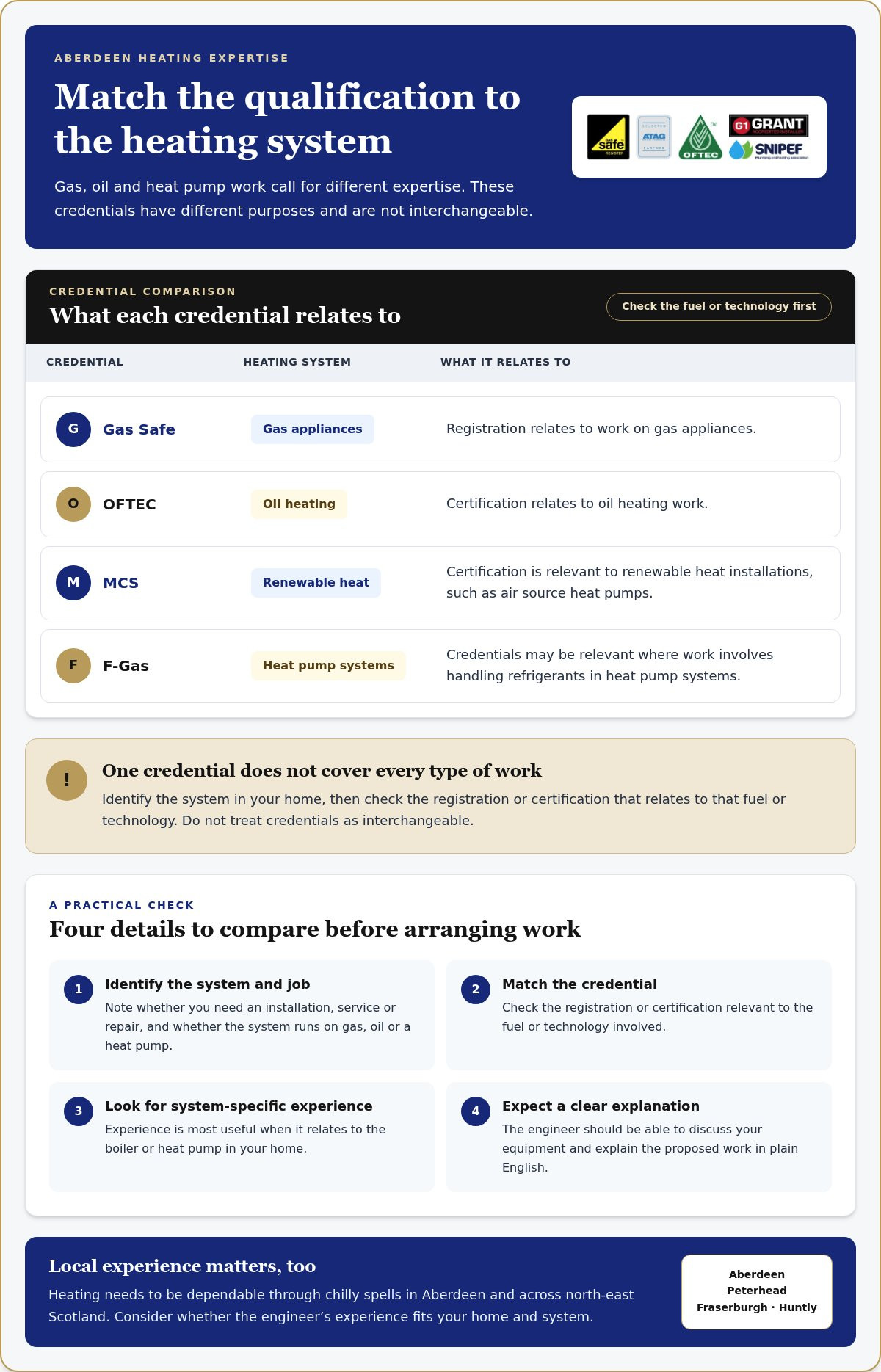
Before arranging work, check that the engineer’s credentials and experience fit your boiler or heat pump. A directory profile or a general claim of heating experience does not show whether someone is qualified for your particular job. First identify the work and the fuel or technology involved. Then check the relevant registration or certification and consider how well the engineer can explain the proposed work.
Qualifications should match the heating system being worked on, because gas, oil and heat pump work call for different, relevant expertise.
Gas Safe registration relates to work on gas appliances. OFTEC relates to oil heating work, while MCS certification is relevant to renewable heat installations such as air source heat pumps. F-Gas credentials may be relevant where work involves handling refrigerants in heat pump systems. Each credential has a different purpose. Trust Boilers lists Gas Safe, OFTEC, MCS and F-Gas credentials relevant to its gas, oil and renewable heating work. For Scottish industry context, SNIPEF’s plumbing and heating information is another useful reference.
Experience is most useful when it relates to the system in your home. If you have an oil boiler, look for relevant oil heating experience. If you are considering a heat pump, seek experience with renewable heating. Trust Boilers has over 30 years of experience in the trade, covering boiler and renewable heating needs. That breadth can be helpful when a project involves more than one type of heating technology.
For an overview of the work involved, see Trust Boilers’ heating services, including boiler work and air source heat pump installation. This can help you identify which type of experience and credentials are relevant to your home.
A directory rating can give you an initial impression, but it cannot show on its own whether an engineer has experience with your boiler or heat pump, or what support follows the work. Compare details that relate directly to your home and the job you need done. A clear explanation of why an approach suits your system is more useful than a profile full of broad claims.
Use these points to compare the information available:
What to compare | What to look for
Relevant credentials | Credentials that match the fuel or technology involved in your job.
System experience | Practical experience with the type of boiler or heat pump in your home.
Explanation | A straightforward account of the recommended work and how it relates to your property.
Aftercare | Clear information about ongoing support and maintenance after installation or repair.
Reviews can offer insight into communication and customer experience, but a rating does not establish that an engineer is suited to every heating system. Look for comments that relate to your needs, then consider them alongside the relevant credentials, experience with the technology and the clarity of the advice. For example, feedback about a boiler service may tell you little about an engineer’s heat pump installation experience.
The recommendation should also make sense for your property. An engineer should take account of your existing heating system and explain how the proposed work fits, rather than offering the same answer to every homeowner. This is useful when comparing options for a home in Aberdeen or nearby communities, where properties and heating setups can differ from one household to another.
Installation choices affect how a system is set up and can shape its maintenance needs later. Considering aftercare at the outset helps you understand what support continues once the installation is complete. Trust Boilers offers a fifteen-year support commitment for installations. For more detail on the installation process, read the boiler installation guide.
The best heating engineer in Aberdeen for your home is the one whose credentials, system experience, explanations and ongoing support fit the work you need. Consider those details together rather than letting a single review score make the decision for you.
Arranging heating work is simpler when you start with the basics: what system you have, what it is doing and what you need help with. Whether you live in Aberdeen or a nearby community, a clear description helps keep the discussion focused on your home instead of a generic solution. Trust Boilers undertakes boiler installation, servicing and repair, air source heat pump installation, and heating care plans.
Before discussing the work, make a note of:
You do not need to diagnose a fault yourself. Describe what you have observed and share the information available to you. Then you can discuss a suitable service and what the work involves. The best heating engineer in Aberdeen should explain the options in relation to your existing system and household needs, without leaving you to interpret technical language alone.
Planned servicing gives a heating specialist the opportunity to check and maintain your system at scheduled intervals. It cannot guarantee that a fault will not occur, but it can help you keep up with routine care and understand the condition of your equipment. The appropriate maintenance depends on the system: gas and oil boilers have different servicing requirements from air source heat pumps.
Trust Boilers offers gas and oil care plans, as well as air source heat pump care plans. If you are considering planned boiler maintenance, the Aberdeenshire boiler care plan guide explains what to consider. Ongoing support can also form part of the discussion when planning a new heating system, so you can consider installation and future care together.
For information about arranging work, visit Trust Boilers’ home heating services.
Choosing a heating business is about more than getting the immediate job done. You also need advice that fits your home, the right expertise for your system and a clear picture of what support may follow. Trust Boilers & Renewables is a local independent business based in Portsoy, serving Aberdeen and communities including Peterhead, Fraserburgh, Huntly, Keith, Buckie, Banff, Aberlour and Elgin.
With more than 30 years of trade experience, the team works across boiler and renewable heating needs. This can be useful if you are maintaining an existing system, considering a replacement or weighing up a different heating approach. It does not mean every home needs the same solution. Your equipment and plans should guide the discussion.
Trust Boilers undertakes boiler installation, servicing and repair, as well as air source heat pump installation and care. The business also provides solar PV panels and battery storage as related renewable energy services. These options have different purposes, so start with what your property needs rather than assuming you should change systems. For a boiler issue, focus on the boiler and its fuel. If you are considering a heat pump, discuss that technology and how it could fit your home.
This range of work can be useful when a home’s energy setup includes more than one technology. You can discuss the heating system alongside related renewable energy equipment and consider how installation, servicing and future maintenance fit together.
Support matters after installation, too. Trust Boilers offers a fifteen-year support commitment for installations, making ongoing assistance a practical part of the project discussion. The business also offers gas and oil care plans and air source heat pump care plans, so routine maintenance can be considered in relation to the system installed.
To assess the best heating engineer in Aberdeen for your home, consider whether the business can discuss your current system, the work you need and what ongoing support looks like. Trust Boilers brings local independent experience to these conversations, serving homeowners across Aberdeen and nearby communities without assuming one solution suits every property.
More information about boiler, heat pump and planned maintenance services is available through Trust Boilers’ heating services.
Start with your home’s heating system and the work it needs. Match qualifications to the job: Gas Safe for gas work, OFTEC for oil, and MCS for renewable heat installations such as air source heat pumps. F-Gas credentials are relevant where work involves handling refrigerants. Then look for practical experience with your type of system, clear explanations and support that continues after installation.
These checks can help you assess the best heating engineer in Aberdeen for your property. Trust Boilers & Renewables is a local independent business with more than 30 years of experience in the trade, serving Aberdeen and nearby communities. Its fifteen-year support commitment for installations is also worth considering when planning a new system and its ongoing care.
If you are considering boiler work, a heat pump or a care plan, discuss your home’s needs with Trust Boilers. Talk to Trust Boilers about your heating to take the next step with a clearer understanding of the options.
Choose an engineer whose qualifications and practical experience match your heating system and the work you need. Check credentials relevant to gas, oil or heat pumps, look for experience with your type of equipment, and consider whether the engineer explains the proposed work clearly. Reviews can provide context, but they should not settle the decision on their own. These checks can help you find the best heating engineer in Aberdeen, Fraserburgh, Peterhead, Huntly, Keith, Buckie, Banff, Aberlour or Elgin.
Yes. In the UK, an engineer working on a gas appliance must be registered with the Gas Safe Register. This applies to gas boiler work, not oil boilers or heat pumps, which have different relevant credentials. Before gas work begins, check that the engineer’s Gas Safe registration covers the work being carried out. This is a practical safety check, not just a general sign of trade experience.
Yes, an engineer or heating business can have experience and relevant credentials across both oil boilers and heat pumps. The key is that experience and qualifications must apply to the specific work. Do not assume one credential covers every system. For oil boiler installation or servicing, look for relevant oil expertise, such as OFTEC registration. For a heat pump installation, MCS certification is relevant, with F-Gas credentials applying where refrigerant handling is involved.
Look for an MCS-certified installer for an air source heat pump. MCS relates to renewable heat installations and can be important if you are seeking eligible funding. F-Gas credentials are relevant if the work involves handling refrigerants. These are separate credentials with different purposes, so one should not be treated as a substitute for the other. Check how the installer’s qualifications relate to the specific heat pump work planned for your home.
Start by identifying your system’s fuel or technology and, if available, its make and model. Describe the issue you have noticed or the work you are planning, then look for a clear explanation that relates to that equipment. Relevant service records or manuals can provide useful context. Trust Boilers & Renewables has over 30 years of experience in the trade, covering boiler and renewable heating work across north-east Scotland.
Arrange a professional boiler service in line with the manufacturer’s guidance and your boiler’s service history. If you are unsure when it was last serviced, check any records or paperwork you have and discuss the next suitable maintenance step. Do not wait for a routine service if the boiler develops a fault or you notice a safety concern. For a gas appliance, have work carried out by an appropriately Gas Safe registered engineer.
Support after installation varies, so include it in your decision alongside the installation itself. Ask what ongoing assistance and maintenance are included for the system being installed, and keep the relevant documents and service records. Trust Boilers & Renewables offers a fifteen-year support commitment for installations, as well as care plans for gas, oil and air source heat pump systems. The suitable option depends on your equipment and needs.
FREE Download

Please complete the form below with your details, and one of our team members will contact you.