
- Call our boiler installation team:
- 01261 394011
Please complete the form below with your details, and one of our team members will contact you.
Why are you still letting a volatile global oil market dictate the temperature of your living room? It’s a question many across Northern Scotland are asking as heating oil prices reached 107p per litre this June. If you’re weighing up the oil to heat pump conversion cost Scotland residents must navigate, you’ve likely spent years monitoring tank levels and tolerating the smell of kerosene. You deserve a more stable, protective approach to your home’s warmth that doesn’t depend on the next delivery truck.
This guide provides a transparent breakdown of the transition in 2026. We’ll show you how the current grant landscape, including the £7,500 Home Energy Scotland grant and the additional £1,500 rural uplift, can significantly lower your initial investment. You’ll gain a clear understanding of the financial transition, the proven performance of air source technology in freezing conditions, and the exact steps required to secure interest-free funding. We’re here to help you move from the uncertainty of oil to the quiet confidence of a modern, efficient home heating system.
For decades, rural Scottish homeowners have been caught in what we call the “Oil Trap”. It’s a frustrating cycle of watching the tank gauge, tolerating the smell of kerosene in the garden, and paying whatever price the delivery truck demands. Converting from a traditional kerosene boiler to an electric air source heat pump (ASHP) isn’t just about changing an appliance. It’s a fundamental shift in how you secure your home’s future comfort. When you evaluate the oil to heat pump conversion cost Scotland homeowners face in 2026, you have to weigh the initial investment against the reality of unregulated fuel. Modern oil boilers are, at best, 90% efficient. This means 10p of every pound you spend literally disappears up the flue. In contrast, an ASHP operates at 300% to 400% efficiency by extracting ambient heat from the environment. To understand the physics behind this, you can read more about how a heat pump works, but the financial result is simple: you stop burning fuel and start moving heat.
In the context of a biting Aberdeenshire winter, SCOP is the figure that truly matters. It measures the heat pump’s efficiency across an entire year, not just on a mild spring day. A well-designed system should deliver a SCOP of at least 3.0. This means for every 1kW of electricity you pay for, you receive 3kW of usable heat for your radiators and hot water. Our coastal air and high humidity in the North East can affect how systems behave, but modern units are engineered to manage these conditions through intelligent defrost cycles. It’s about ensuring your system is protective and reliable, even when the haar rolls in or the temperature drops below zero.
If you live in Banff or Huntly, you know that oil prices don’t just fluctuate; they can skyrocket overnight due to supply chain issues or sudden cold snaps. Whilst electricity prices are managed under national caps, heating oil remains a volatile market. Many households previously relied on expert boiler installation in Aberdeenshire as the standard choice, but 2026 represents a genuine tipping point. With the introduction of more stable renewable tariffs and the phasing out of fossil fuel reliance, the long-term financial safety of a heat pump is becoming impossible to ignore. The oil to heat pump conversion cost Scotland residents invest today is essentially a hedge against the next global oil crisis. It provides a level of price stability that a kerosene tank simply cannot offer.
Have you looked at your oil tank recently and wondered what it would take to finally get rid of it? Breaking down the oil to heat pump conversion cost Scotland residents face requires looking beyond the price of the pump itself. This is a multi-stage engineering project that transforms how your home breathes and stays warm. The core components include the external air source unit and a specialised internal hot water cylinder. However, the initial phase often involves professional oil tank decommissioning. This isn’t just about hauling away plastic or metal; it requires the safe disposal of residual kerosene and a certificate of environmental compliance to protect your property’s soil and water quality.
Once the old system is out, the focus shifts to system integration and protection. Your existing radiators and pipes have spent years circulating oil-heated water, which often leaves behind metallic sludge and debris. To protect your new investment, a thorough power flush is vital. Without this step, old contaminants can clog the heat pump’s delicate heat exchanger, leading to poor performance or premature failure. This is why choosing an MCS-accredited installer is non-negotiable. Not only does it ensure the work meets rigorous safety standards, but it’s also the primary requirement for accessing the £7,500 Scottish government grant. Cutting corners on professional commissioning can often lead to a higher oil to heat pump conversion cost Scotland homeowners have to pay in the long run through repairs and lost efficiency.
One of the biggest misconceptions is that every radiator in your home must be replaced. Whilst oil boilers blast water at 70°C, heat pumps operate more efficiently at lower temperatures, typically around 45°C to 55°C. In many cases, we only need to resize a few select radiators in larger rooms to ensure they have enough surface area to keep you warm. Switching to modern aluminium radiators can also significantly improve heat transfer efficiency, helping the system maintain your comfort without working harder than it needs to.
Heat pumps require a specific unvented hot water cylinder with a much larger internal coil than a standard oil-fired version. This is necessary to transfer heat effectively at those lower operating temperatures. If your home in Moray or the Highlands uses older 10mm microbore pipework, some sections may need upgrading to ensure adequate flow rates. This ensures the pump can move heat around the house without restriction. If you’re concerned about your existing setup, our team can provide a detailed assessment during an Air Source Heat Pump Installation consultation to ensure your pipework is ready for the transition.
How does a heat pump actually handle a Moray winter? It’s the question we’re asked most often by homeowners in Elgin, Keith, and Inverurie. To provide a clear answer, we can look at a 4-bedroom detached property in Elgin that made the switch in early 2026. Previously, this household was burning through 2,500 litres of heating oil annually. The owners were tired of the “on/off” nature of their old system, which left rooms feeling draughty between boiler cycles, not to mention the constant anxiety of monitoring the tank levels during a cold snap. When evaluating the oil to heat pump conversion cost Scotland residents must consider, this family prioritised long-term stability and comfort over simply replacing like-for-like. Before committing, they also wanted to understand whether a heat pump was suitable for their home given the property’s age and insulation levels.
The solution was a bespoke air source heat pump installation Aberdeenshire specialists designed specifically to handle the property’s heat loss profile. During a particularly harsh week where outside temperatures plummeted to -8°C, the system maintained a consistent 21°C throughout the living areas. The feedback from the homeowners was immediate. They noticed the house felt “solidly warm” rather than just having pockets of heat near radiators. This transition from aggressive bursts of high-temperature heat to a steady, ambient temperature is the hallmark of a correctly sized renewable system. It’s a protective approach to home heating that ensures the fabric of the building stays warm, preventing the damp and cold spots often associated with older oil systems.
The reliability of this Elgin installation relies heavily on smart weather compensation. This feature uses external sensors to monitor the North Sea winds and temperature drops in real-time. Instead of the system working at 100% capacity regardless of the weather, it adjusts its output incrementally. This prevents “short-cycling”, where the pump turns on and off too frequently. By keeping the compressor running at a steady, low level, we extend the lifespan of the equipment and ensure it operates at peak efficiency even when the frost lingers on the ground. It’s about working with the Scottish climate rather than fighting against it.
Beyond the daily comfort, the financial benefits extend to the property’s market value. By removing the oil boiler and installing an ASHP, this Elgin home jumped from an EPC Band E to a Band B. In the current Scottish housing market, a high energy efficiency rating is a significant asset for future resale. If you’re looking for a more detailed breakdown of the investment required for your specific property type, you can explore our air source heat pump cost Scotland guide. This shift to low-carbon heating doesn’t just lower your carbon footprint; it secures the equity in your home whilst removing the volatility of the oil market for good.
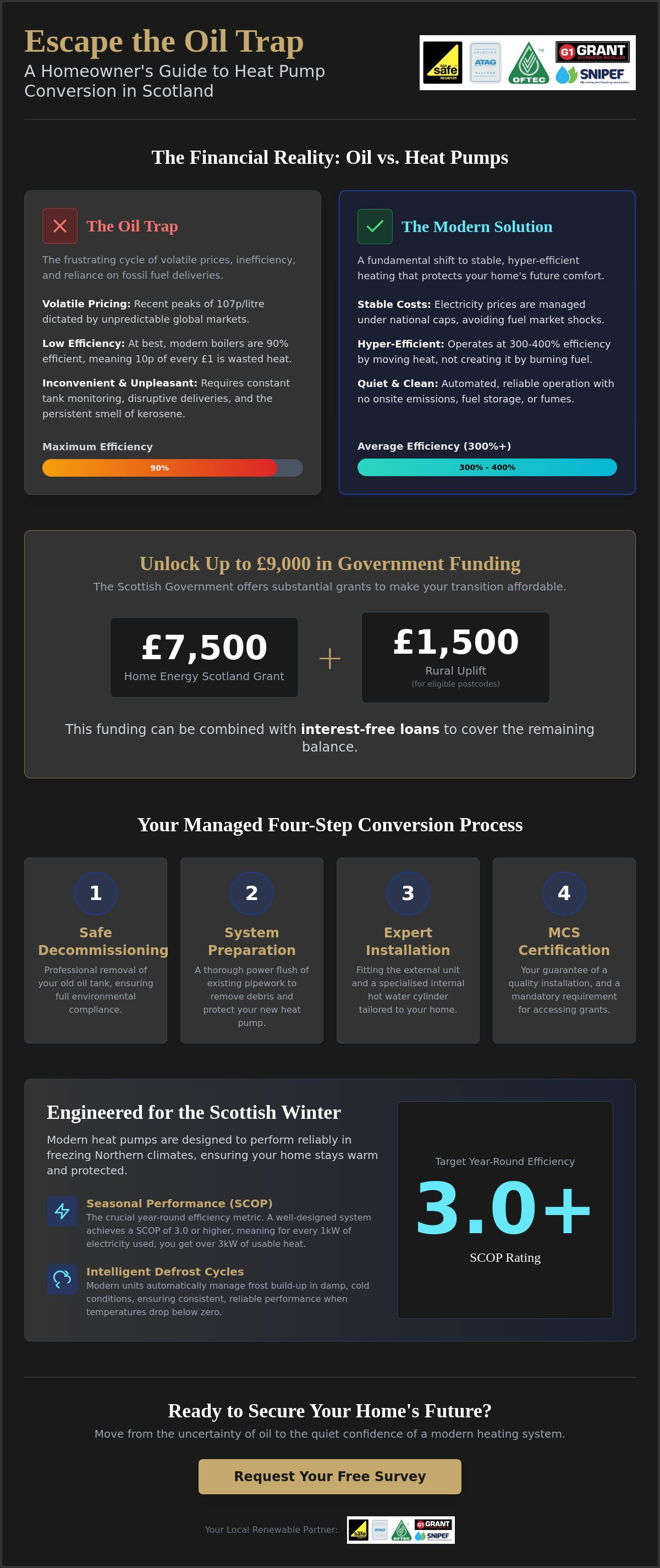
How do you bridge the gap between wanting a cleaner heating system and managing the upfront investment? In Scotland, the financial barrier is significantly lower than in other parts of the UK thanks to a uniquely supportive funding landscape. Whilst homeowners in England and Wales navigate a different scheme, Scottish residents can access the Home Energy Scotland (HES) Grant. As of June 2026, the standard grant for an air source heat pump stands at £7,500. This is a non-repayable sum designed to protect your household budget whilst you transition away from fossil fuels. It directly offsets the oil to heat pump conversion cost Scotland residents face, making the switch more accessible for traditional family homes.
For those living in more remote areas, the support is even more robust. If your property is located in a designated rural or island postcode, you may qualify for an additional £1,500 rural uplift. This brings your total potential grant to £9,000. If a gap remains between the grant and the total installation price, you can apply for an interest-free loan of up to £7,500. This loan carries a modest 1.5% administrative fee, capped at £150, and allows you to spread the remaining balance over five to ten years. All installations currently benefit from a 0% VAT rate, a relief scheduled to remain in place until 31 March 2027. This combination of grants, interest-free finance, and tax relief creates a vital safety net for your home’s energy future.
Timing is everything when it comes to securing government funds. You must follow a specific sequence to ensure your application isn’t rejected. First, you need a valid Energy Performance Certificate (EPC) that recommends a heat pump. Second, you must obtain a formal quote from an MCS-certified specialist like Trust Boilers & Renewables. Most importantly, you must submit your application to Home Energy Scotland and receive your funding offer BEFORE any work commences on-site. If you start the installation early, you risk losing the entire grant. We can help you navigate this process during your Air Source Heat Pump Installation assessment to ensure every box is ticked.
To achieve the lowest possible running costs, many Scottish homeowners are looking at “Renewable Bundles”. By installing solar panels alongside your heat pump, you can use the free electricity generated on your roof to power the pump’s compressor. The Scottish government often provides additional grant modules for solar PV and battery storage when installed as part of a wider energy efficiency package. During the long Scottish summer days, this combination can result in near-zero heating and hot water costs. It’s a proactive way to insulate yourself from future electricity price rises whilst doing your bit for the Highlands’ environment.
Are you ready to stop worrying about your oil levels and start enjoying consistent, reliable warmth? Choosing a local specialist isn’t just about convenience; it’s about ensuring your system is designed for the specific challenges of the Aberdeenshire coast. At Trust Boilers & Renewables, we serve homeowners across Fraserburgh, Peterhead, and the wider Aberdeenshire area with a focus on long-term reliability. We understand that the oil to heat pump conversion cost Scotland families invest is a significant decision. That’s why we manage the entire journey for you. From the technical challenge of safe oil tank removal to the final MCS certification required for your grant, our team acts as your proactive advisor throughout the process.
Our involvement doesn’t end when the pump is commissioned. We provide dedicated local air source heat pump servicing to ensure your system remains within its warranty and continues to operate at peak efficiency. This “peace of mind” philosophy is at the heart of what we do. We want you to have the confidence that your Highland home will stay warm, regardless of how low the temperature drops outside. By choosing a partner that stays for the long haul, you’re not just buying an appliance; you’re securing a decade of expert support and technical mastery.
Why is annual maintenance so critical? If you’ve received government funding, regular professional checks are often a mandatory requirement to keep your grant status valid. Our ASHP care plans are designed to be protective, covering essential efficiency checks, refrigerant levels, and filter cleaning. These regular visits prevent minor issues from becoming costly repairs. By investing in a structured maintenance schedule, you ensure your system reaches its full 20-year expected lifespan, protecting your initial oil to heat pump conversion cost Scotland investment for decades to come.
Every home is unique, which is why we never provide generic, “off-the-shelf” estimates. We conduct a rigorous, room-by-room heat-loss calculation for your specific property to determine the exact size of pump and radiators you need. Our pricing is completely transparent, with no hidden rural surcharges for our neighbours in more remote Highland postcodes. We believe in doing things correctly the first time, reinforcing our commitment to quality and efficiency. Ready to take the first step toward energy independence? Contact Trust Boilers & Renewables today for your oil-to-heat-pump assessment and discover how we can transform your home’s comfort.
Transitioning from kerosene to a modern air source heat pump offers a level of price stability that the unregulated oil market simply cannot match. We’ve explored how the 2026 grant landscape provides robust support, ensuring the initial oil to heat pump conversion cost Scotland residents face is a manageable investment for the future. It is time to move away from the uncertainty of monitoring tank levels and toward a system engineered specifically for our unique North Sea climate.
As MCS Certified Installers serving Aberdeenshire, Moray, and the Highlands, we take the stress out of your renewable journey. Our team brings deep expertise in Scottish Government grant applications and bespoke system design to ensure your home remains a protective sanctuary. If you’re ready to achieve energy independence and long-term peace of mind, we are here to guide you through every step of the process.
Book your free oil-to-heat-pump conversion survey with Trust Boilers & Renewables
You deserve a warm, efficient home that’s built for the long haul.
Running costs are typically lower or comparable for a correctly designed system, especially given the volatility of heating oil prices which averaged 107p per litre in June 2026. Whilst an oil boiler is roughly 90% efficient, an air source heat pump delivers 300% to 400% efficiency by moving heat rather than burning fuel. This high efficiency helps to offset the cost of electricity, providing a more stable and predictable monthly energy bill for your household.
You can often keep many of your existing radiators, though some may require resizing to work effectively at lower flow temperatures. Heat pumps operate most efficiently when they provide a steady flow of warm water rather than the intense bursts of heat produced by oil boilers. During our initial survey, we calculate the heat loss for each room to determine if your current radiators have enough surface area to keep you comfortable.
Scottish homeowners can currently access a standard grant of £7,500 through Home Energy Scotland. If you live in a designated rural or island area, you may be eligible for an additional £1,500 uplift, bringing the total non-repayable grant to £9,000. This funding significantly reduces the initial oil to heat pump conversion cost Scotland residents pay, and an optional interest-free loan is also available to cover any remaining balance.
Modern air source heat pumps are specifically engineered to operate reliably in temperatures as low as -20°C. These systems are common across Scandinavia and are perfectly suited for Highland winters when installed by specialists who understand local conditions. Features like intelligent defrost cycles and weather compensation ensure that your home stays at a consistent, comfortable temperature even during the coldest northern nights.
A full conversion typically takes between three and five days to complete from start to finish. This timeframe includes the professional decommissioning and removal of your old oil tank, the installation of the external pump and internal cylinder, and any necessary radiator upgrades. We aim to minimise disruption to your daily routine, ensuring that your new system is commissioned and fully operational as quickly as possible.
Most installations fall under “Permitted Development” and don’t require formal planning permission as long as they meet specific noise and boundary criteria. However, if your property is a listed building or located within a conservation area, you may need to submit an application to Aberdeenshire Council. We can provide guidance on these requirements during our assessment to ensure your installation remains fully compliant with local regulations.
We manage the entire decommissioning process to ensure your old tank is removed safely and responsibly. This involves draining any residual kerosene, disconnecting the fuel lines, and transporting the tank to a specialist recycling facility. This professional approach protects your property from potential leaks and ensures that the transition to your new renewable heating system is clean and environmentally sound.
No home is inherently too old for a heat pump, but adequate insulation is vital for the system to run at peak efficiency. Home Energy Scotland requires a valid Energy Performance Certificate (EPC) as part of the grant application process. If your EPC suggests that loft or cavity wall insulation is needed, it’s often best to address these areas first to ensure your new system provides the best possible performance and value. For a comprehensive overview of the exact criteria that determine suitability, our guide on whether a heat pump is suitable for your Scottish home covers insulation requirements, noise regulations, and funding eligibility in detail.
FREE Download

Please complete the form below with your details, and one of our team members will contact you.