

- Call our boiler installation team:
- 01261 394011
Please complete the form below with your details, and one of our team members will contact you.
Most solar panels in Moray are effectively “off the clock” by the time you actually need them. While your system works hard during the Highland afternoon, that green energy often trickles back to the grid for pennies whilst you pay full price for electricity later that evening. It’s a frustrating cycle that leaves many homeowners in Elgin and Buckie wondering why their bills remain stubbornly high. A professional solar battery retrofit Moray can change this dynamic entirely. By capturing your surplus generation during the day, you can finally stop gifting power to the grid and start using it on your own terms.
We understand the confusion surrounding technical choices like AC versus DC coupling, especially when you’re worried about how batteries handle a biting Scottish winter. You want a system that’s reliable, safe, and actually pays for itself. This 2026 guide will show you how to transform your current setup into a resilient, 24/7 power station. We’ll explore the current 0% VAT benefits available until March 2027, explain how to navigate SSEN grid applications, and help you select a storage solution that thrives in our unique northern climate.
Have you ever checked your generation meter on a bright Moray afternoon and felt a pang of frustration? You can see your panels working hard, yet you know that most of that green energy is being pushed back to the grid for a fraction of what it costs to buy back later. This is the “surplus problem” facing thousands of households from Elgin to Buckie. A professional solar battery retrofit Moray is the specialist solution to this imbalance. Essentially, retrofitting is the process of adding home energy storage capacity to a solar PV system that was originally installed without it.
In 2026, the primary driver for this upgrade has shifted. It’s no longer just about the novelty of green tech; it’s about the cold, hard logic of self-consumption. With the 0% VAT rate on energy-saving materials set to continue until March 2027, retrofitting has become the most effective way to insulate your home from the rising costs of grid power. For our rural communities amongst the hills of Aberlour or the coastal stretches of Banff, this also offers a vital layer of energy security. It reduces reliance on a national grid that can be vulnerable during harsh northern winters, giving you peace of mind when the weather turns.
Many homeowners worry that their older equipment might be obsolete or incompatible with modern storage. Whether you have a traditional string inverter or a modern micro-inverter setup, the good news is that almost any system in Moray can be upgraded with the right hardware. Retrofit compatibility is the ability of a new battery inverter to communicate with an existing PV array. By using an AC-coupled approach, we can install a battery alongside your current inverter without needing to replace your original panels. This ensures your system remains efficient whilst protecting your initial investment.
The financial math for solar has changed significantly. While the Smart Export Guarantee (SEG) pays you for the power you send back, these rates are often far lower than the price you pay to run a heat pump or boil a kettle in the evening. By storing that energy instead, you effectively “buy” it from yourself for free. When paired with “Time of Use” tariffs, your battery can even charge from the grid during cheap off-peak hours. This protective measure ensures that no matter how volatile energy markets become, your home remains a stable, cost-effective sanctuary. Investing in a solar battery retrofit Moray allows you to take full control of your energy independence for the long haul.
When you begin planning a solar battery retrofit Moray, the most significant technical decision you’ll face is whether to choose an AC-coupled or DC-coupled system. It sounds like complex jargon, but it’s simply a matter of where the battery sits in your home’s electrical loop. Most existing solar installations in Moray use a standard inverter to turn solar power (DC) into usable household power (AC). An AC-coupled retrofit adds a second, separate battery inverter. A DC-coupled system replaces your existing unit with a “hybrid” version. Both have their place, but the right choice depends entirely on your current hardware and your long-term goals for energy independence.
One critical component that often gets overlooked in basic guides is the Smart Gateway, or Gateway Meter. Think of this as the intelligent traffic warden of your home. It monitors exactly how much power your panels are making and how much your house is using in real-time. Without this precise data, your battery wouldn’t know when to charge from the sun or when to hold back for the evening peak. This gateway is the brain that allows you to manage power flow effectively, ensuring you aren’t accidentally exporting energy whilst your battery is half-empty.
AC-coupled systems are the favourite choice for existing installations in Keith or Huntly. Because these systems sit alongside your current inverter, we don’t need to replace your original equipment or disturb your existing solar warranties. It’s a “plug and play” approach that works with almost any brand of panels. This flexibility also makes it easier to scale. If your energy needs grow, perhaps because you’ve added an electric vehicle, you can often add multiple batteries to an AC-coupled setup with minimal fuss. It’s a straightforward, protective way to upgrade without a total system overhaul.
In 2026, hybrid inverters have reached a level of maturity that makes DC-coupling very attractive for newer solar arrays. By keeping the power in DC format for longer, you avoid the efficiency losses that occur when converting power back and forth between AC and DC. Whilst these losses are small, they add up over a decade of use. This route is particularly sensible if your original inverter is nearing the end of its lifespan or if you are looking at Scottish Government renewable energy schemes to help fund a more comprehensive home energy upgrade.
Every time you convert energy from DC to AC and back again, you lose a tiny percentage of power as heat. Whilst AC systems are easier to install, DC systems are slightly more “loss-less.” Choosing the best fit requires a look at your roof’s current performance and your household’s peak demand. If you’re feeling unsure about which technical path to take, you can learn more about solar PV and battery storage Scotland to see how these systems perform in our specific northern light conditions.
How do you ensure your storage solution actually works when the sun sets at 3:30 PM in December? Planning a solar battery retrofit Moray requires a bit more thought than just picking the biggest unit on the shelf. Because our daylight hours vary so dramatically between the summer solstice and the winter solstice, we use what we call the “Goldilocks” approach. A battery that’s too small will fill up by 10:00 AM in July, leaving you exporting energy for the rest of the day. Conversely, a battery that’s too large will sit half-empty for most of the winter, never providing the return on investment you expect.
To get the sizing right, we first calculate your “Baseload” and your “Peak evening demand.” Your baseload is the background hum of your home, things like your fridge-freezer and items on standby. Your peak demand is the spike that happens when you’re cooking dinner or doing laundry. By matching your battery capacity to these specific habits, we ensure you maximise self-consumption. For a deeper look at the technical fundamentals, the Energy Saving Trust guide to battery storage provides an excellent benchmark for how these systems interact with typical UK household loads.
In 2026, the industry has largely standardised on Lithium Iron Phosphate (LFP) technology. We prefer LFP for Moray homes because it is significantly more stable than older lithium-ion chemistries. These batteries offer a longer lifespan and better safety profiles, which is vital when the equipment is installed in a garage or utility room. They also handle the varying discharge rates required by modern appliances without degrading prematurely.
Batteries can be sensitive to the biting temperatures we often see in Speyside or the Highlands. Modern units now include internal heaters to maintain optimal performance even when it’s freezing outside. During the darkest Moray months, you can use a “Force Charge” feature to top up your battery from the grid using cheap overnight tariffs. This ensures you have a full tank of energy ready for the morning rush, regardless of whether the sun shines. Depth of Discharge is the percentage of a battery’s capacity that can be safely used without causing long-term damage to the cells.
It’s wise to think about where your home will be in five years. If you’re considering an electric vehicle or want to know how do air source heat pumps work, your battery sizing should reflect that future demand. These high-load appliances can drain a small battery in minutes. By choosing a modular system now, you can start with a sensible capacity today and add more storage blocks as your “green” fleet grows. This integrated approach gives you total control over your home’s energy environment for the long haul.
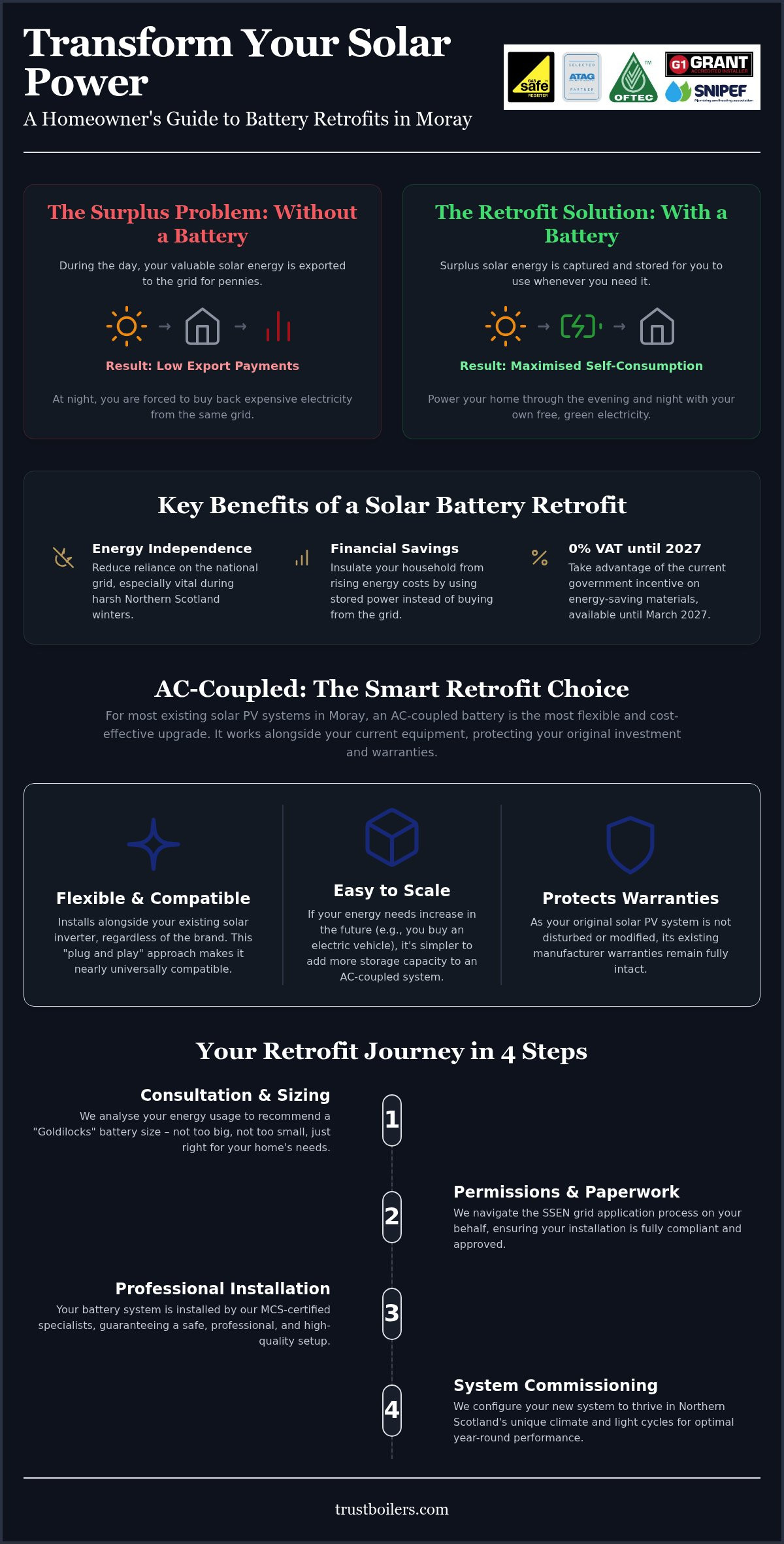
What happens once you decide to upgrade? The journey toward a professional solar battery retrofit Moray starts with a comprehensive technical survey. This isn’t just about checking your fuse box; it’s about identifying the safest location for your storage unit. We look for a site with proper ventilation and strict adherence to fire safety standards, typically in a garage or a dedicated utility centre. Once the survey is complete, we handle the technical design to ensure your new battery communicates perfectly with your existing panels. After the physical installation, which usually takes less than a day, we provide the final MCS certification that confirms your system meets the highest UK safety and performance benchmarks.
The financial landscape for renewables has changed. It’s vital to know that as of 2026, the Home Energy Scotland (HES) grant and loan programme has shifted its focus away from standalone battery storage and now prioritises clean heating and insulation. However, you can still benefit from the 0% VAT rate on energy-saving materials, which is confirmed to remain in place until 31st March 2027. For low-income households in areas like Keith or Buckie, the ECO4 scheme remains a potential avenue for funding until December 2026. To navigate these options, you can consult our renewable energy grants Scotland guide for the most current advice. Always ensure your installer is MCS certified, as this remains a non-negotiable requirement for almost all government-backed incentives.
How long does the paperwork take? In Moray, your system must be registered with Scottish and Southern Electricity Networks (SSEN). If your battery’s export capacity is under 3.68kW, we typically follow the G98 process, which is a simple notification after the work is done. However, for larger systems common in rural Banff or Elgin, a G99 application is required before we even pick up a screwdriver. This permission is crucial because local grid constraints can sometimes dictate your battery’s maximum discharge power. At Trust Boilers & Renewables, we manage this entire application on your behalf. Whilst approval timelines can vary, we usually see G99 permissions granted within four to six weeks for most Moray properties.
Taking the first step doesn’t have to be stressful. If you want to ensure your home is prepared for the years ahead, we can help you organise a professional solar battery installation that fits your specific needs and local grid requirements.
Why does local expertise matter when upgrading your home energy system? If you have a question about your battery settings or need a quick check-up after a heavy Speyside storm, you don’t want to be stuck in a national call centre queue. You want a specialist who is just down the road in Elgin or Keith. Choosing a local partner for your solar battery retrofit Moray ensures that you have a dependable neighbour ready to help when it counts. We pride ourselves on a sense of quiet confidence; we don’t need high-pressure sales tactics because our technical mastery speaks for itself. For a wider perspective on how these systems are evolving across the region, you can explore our guide to solar PV and battery storage Scotland.
Our commitment to your home doesn’t end once the last wire is connected. We believe in being a Reliable Guardian for your property, which is why we offer the option to integrate your new storage system into our existing heating care plans. This holistic approach means that your solar, battery, and heating systems are all looked after by the same team of experts. It provides a level of stability and peace of mind that a one-time contractor simply cannot provide.
Our history is rooted in the communities of Aberdeenshire and Moray. Unlike many solar-only firms, our background is in complex heating and plumbing systems. We understand the “whole house” energy flow, from how your heat pump draws power to how your boiler interacts with smart controls. This deeper technical knowledge makes us more effective renewable installers. We act as a Proactive Advisor, identifying ways to optimise your setup so you don’t have to worry about the technical details yourself. We’re not just installing hardware; we’re building a long-term relationship based on integrity and safety.
Taking the next step toward energy independence is straightforward. Whether your property is in Elgin, Buckie, or Aberlour, we can visit for a local survey to assess your current panels and electrical setup. To help us design the most efficient solar battery retrofit Moray for your specific needs, it’s helpful to have a few details ready for our first visit. We’ll typically ask to see your recent energy bills to map your usage and check the model of your existing solar inverter. This data allows us to ensure your battery is perfectly sized for your household’s unique rhythm. If you’re ready to transform your home into a 24/7 power station, book your solar battery retrofit survey today and let’s get started.
Transforming your existing solar panels into a 24/7 power station is the most effective way to protect your home from energy price volatility. By choosing a solar battery retrofit Moray, you stop gifting your surplus generation to the grid and start using it when you actually need it. Whether you opt for the flexibility of an AC-coupled system or a high-efficiency hybrid upgrade, the focus remains on maximising your self-consumption throughout our long northern winters.
As local Moray and Aberdeenshire specialists, we understand the specific requirements of the Scottish grid and the importance of professional MCS-accredited installation. We handle the complex SSEN permissions on your behalf, ensuring your system is safe, legal, and optimised for longevity. It’s about more than just hardware; it’s about the peace of mind that comes from knowing your home is prepared for 2026 and beyond.
If you’re ready to stop wasting green energy and start lowering your bills, we’re here to help. Request a professional solar battery retrofit quote for your Moray home and take the first step toward true energy independence. Your home’s future is bright, and we’re proud to help you power it.
Yes, you can certainly add storage to an older system. Most 10-year-old installations in Elgin or Keith use standard string inverters that are perfectly compatible with modern hardware. By using an AC-coupled solar battery retrofit Moray, we connect the battery to your home’s wiring rather than the panels themselves. This means your original setup can continue working exactly as it is without risking your existing Feed-in Tariff payments.
The total investment for a retrofit depends on the storage capacity and the technical requirements of your property. Whilst we don’t provide fixed online pricing due to the bespoke nature of Scottish electrical grids, factors like the battery’s chemistry and the need for a G99 application with SSEN will influence the final figure. We recommend a local survey in Buckie or Banff to provide an accurate quote tailored to your home.
You don’t necessarily need to replace your current inverter. If we install an AC-coupled system, your existing solar inverter remains in place and continues its job. However, if your inverter is nearing the end of its typical 12-year lifespan, it might be more cost-effective to replace it with a modern hybrid inverter. This “DC-coupled” approach is slightly more efficient and simplifies your setup into one single, intelligent unit.
A standard battery installation won’t automatically provide power during a blackout. To keep your lights on in Aberlour or Huntly when the grid goes down, you need a system equipped with an Emergency Power Supply (EPS) or a specific “Gateway” device. This hardware allows the battery to “island” your home from the grid, providing a reliable backup for essential circuits like lighting and your fridge-freezer during local power cuts.
The physical installation of a solar battery retrofit Moray usually takes less than one day. Our engineers in Elgin can typically complete the wiring and commissioning with minimal disruption to your power supply. However, the full process includes the administrative side. If your system requires a G99 application with SSEN, the grid approval process can take between four and six weeks before the physical work on your property can begin.
As of September 2026, the Home Energy Scotland grant and loan scheme no longer covers standalone solar panels or battery storage. The most significant financial benefit is the 0% VAT rate on energy-saving materials, which is scheduled to remain in place until 31st March 2027. Some low-income households in Moray may still find support through the ECO4 scheme, which is currently scheduled to run until the end of December 2026.
The best location is a dry, ventilated space that stays within a stable temperature range. Garages or utility rooms in Moray homes are the most popular choices. Whilst modern Lithium Iron Phosphate (LFP) batteries include internal heaters for cold Highland winters, keeping them in an insulated area helps maintain peak efficiency. We always prioritise safety-first placement, ensuring the unit meets all current fire safety regulations whilst remaining accessible for maintenance.
You can absolutely charge your battery from the grid, which is a vital strategy during dark Moray winters. By using a “Time of Use” tariff, you can organise your system to “Force Charge” during cheap off-peak hours overnight. This allows you to fill your battery with low-cost electricity and use it during the expensive breakfast peak, ensuring your system provides financial value even when the winter sun isn’t shining.
FREE Download

Please complete the form below with your details, and one of our team members will contact you.
