

- Call our boiler installation team:
- 01261 394011
Please complete the form below with your details, and one of our team members will contact you.
Does it really make sense to invest in solar panels when the Scottish winter feels like one long twilight? It’s a question we hear often from homeowners who are tired of watching their energy bills climb despite the grey skies. You’ve likely felt that same frustration when the heating kicks in and the meter starts spinning. We understand the hesitation. However, the secret to making solar PV and battery storage Scotland work for you isn’t about chasing “peak sun”; it’s about capturing every bit of light we do get and storing it for when you actually need it.
In this 2026 guide, we’ll show you how combining modern panels with advanced battery technology can help you achieve genuine energy independence. You’ll discover how to protect your home from grid price spikes and why the 0% VAT rate available until 31 March 2027 makes this the ideal time to act. We will walk you through the latest performance data for Northern climates, the reality of winter generation, and how to ensure your installation is handled by a reliable, MCS-certified specialist who prioritises your home’s long-term efficiency and safety.
Is the Scottish weather simply too grey for solar? It is a question we hear from homeowners in Moray and Aberdeenshire almost every week. The short answer is a resounding yes, but the “how” is where things get interesting. A combined system of solar PV and battery storage Scotland works as a partnership. The panels act as the harvester, gathering energy from the sky, whilst the battery serves as the larder, storing that energy for when the sun goes down. Understanding how a solar PV system works helps demystify the process; it is about light, not just heat.
Many people assume you need a cloudless sky to generate power. In reality, modern panels are designed to capture “diffuse light,” which is the light scattered by our frequent Scottish clouds. While a bright day is always better, your system continues to produce electricity even when the weather is typically “dreich.” Our Northern latitude also provides a hidden bonus. During the summer months, our daylight hours are significantly longer than those in Southern England. This creates a massive window for energy generation that compensates for the shorter winter days. If you’ve heard otherwise, our detailed guide on solar panels Moray debunking common myths for Scottish homeowners addresses the most persistent misconceptions that hold local residents back from making this investment.
Modern PV cells are far more sophisticated than the technology of a decade ago. They respond to a broad light spectrum, meaning they don’t need a “blue sky” day to be productive. Today’s high-efficiency inverters are also programmed to start up much earlier in the morning, capturing the very first rays of dawn whilst light levels are still low. Perhaps most surprisingly, the cooler temperatures found in the Highlands actually help your system. Solar panels are more efficient in the cold. Excessive heat can cause electrical resistance that reduces output, so our crisp Scottish air actually keeps your equipment running at its peak.
A standalone solar system without a battery often wastes about 50% of its potential. This happens because the panels are most productive when you are likely out of the house, and that energy is simply sent back to the grid for a low return. By 2026, battery technology has evolved to bridge this gap perfectly. Whether you choose lithium-ion or newer salt-water variations, these units are now robust enough to handle Northern temperature swings. They ensure you aren’t just generating power, but actually using it. Self-Consumption is the percentage of solar energy used directly by the home.
How many times have you boiled the kettle at 6pm and wondered if you’re just paying the highest possible rate? Without a way to keep the energy your panels gathered at noon, that’s exactly what happens. Investing in solar PV and battery storage Scotland transforms your home from a passive consumer into an active energy manager. The system uses a “charge cycle” logic; it prioritises powering your home first, then fills the battery with excess energy, and only sends power to the grid once your storage is full. This ensures that the energy you harvested during a bright morning in Banff is ready for you when the sun goes down.
Grid independence is about more than just saving money; it is about reliability. For our clients in rural Aberdeenshire, a battery acts as a vital safeguard against frequent winter power cuts. When the grid fails during a storm, your battery can kick in to keep essential lights and heating controls running. This shift toward local resilience is a key part of the current Scottish Government BESS policy, which encourages homeowners to take control of their own supply. If you’re unsure how much capacity your specific property requires, we can help you assess your home’s energy profile to find the right fit.
It’s almost always more profitable to use your own power than to sell it back. With export rates often sitting around 12p per kWh and buying rates significantly higher, every unit you store is worth more in your home than in the grid. In 2026, smart tariffs have become the standard. These allow your battery to “top up” from the grid at 3am when electricity is at its cheapest. This way, even if the following day is particularly overcast, you’ve already secured low-cost energy to see you through the morning rush. Matching your battery size to your evening behaviour is essential; a family of four will need a different capacity than a single occupant.
If you already have solar panels installed on your Moray home, you aren’t locked out of these benefits. Retrofitting a battery is a straightforward process. Most older Scottish arrays use AC-coupled installations, which allow a battery to be added without replacing your existing solar inverter. 2026 is an ideal year for this upgrade because the 0% VAT rate still applies to these installations until early 2027. It’s a practical way to modernise an aging system and significantly reduce your monthly outgoings whilst protecting your home’s energy future.
Is the initial expense of a renewable system actually worth the long-term saving? When looking at solar PV and battery storage Scotland, the conversation often focuses on the upfront price; however, the real value lies in “future-proofing.” With energy prices remaining volatile, generating your own power acts as a shield against grid price spikes. While export rates for the Smart Export Guarantee (SEG) have seen adjustments, such as Octopus reducing their rate to 12p per kWh in early 2026, the primary financial gain still comes from avoiding the high cost of importing electricity. By using what you generate, you’re effectively “buying” your power at a fixed, much lower rate for the next two decades.
Solar is remarkably low-maintenance. Beyond the occasional check to ensure the panels are clear of debris, the lack of moving parts means these systems are built for longevity. This reliability adds tangible value to your property. In the Highlands and Aberdeenshire, a high Energy Performance Certificate (EPC) rating is increasingly vital for home sales. Potential buyers are now prioritising properties with lower running costs and established green credentials, making your installation a significant asset if you ever decide to move.
The landscape for funding has changed recently. While the Home Energy Scotland solar loan program closed in June 2024, other avenues still provide relief. The most significant current benefit is the 0% VAT rate on residential installations, which remains in effect until 31 March 2027. This can result in a saving of approximately £2,000 on a typical system. Local, MCS-certified installers are essential here; they understand the specific regional criteria for any emerging local authority schemes or the UK-wide Warm Homes Plan allocations that may apply to your specific postcode. For a comprehensive breakdown of every funding option currently available, including how a rural postcode could unlock up to £18,000 in support, our guide to renewable energy grants Scotland homeowners can access in 2026 covers the full picture in detail.
It’s best to view this as a medium-term investment rather than a quick fix. According to 2026 Scottish renewable energy data, the average system in Scotland now pays for itself within 7 to 10 years. Once that threshold is crossed, your electricity is essentially free for the remainder of the equipment’s life. Most Tier 1 panels now come with 25-year performance warranties; this ensures your investment remains productive and protected for decades to come.
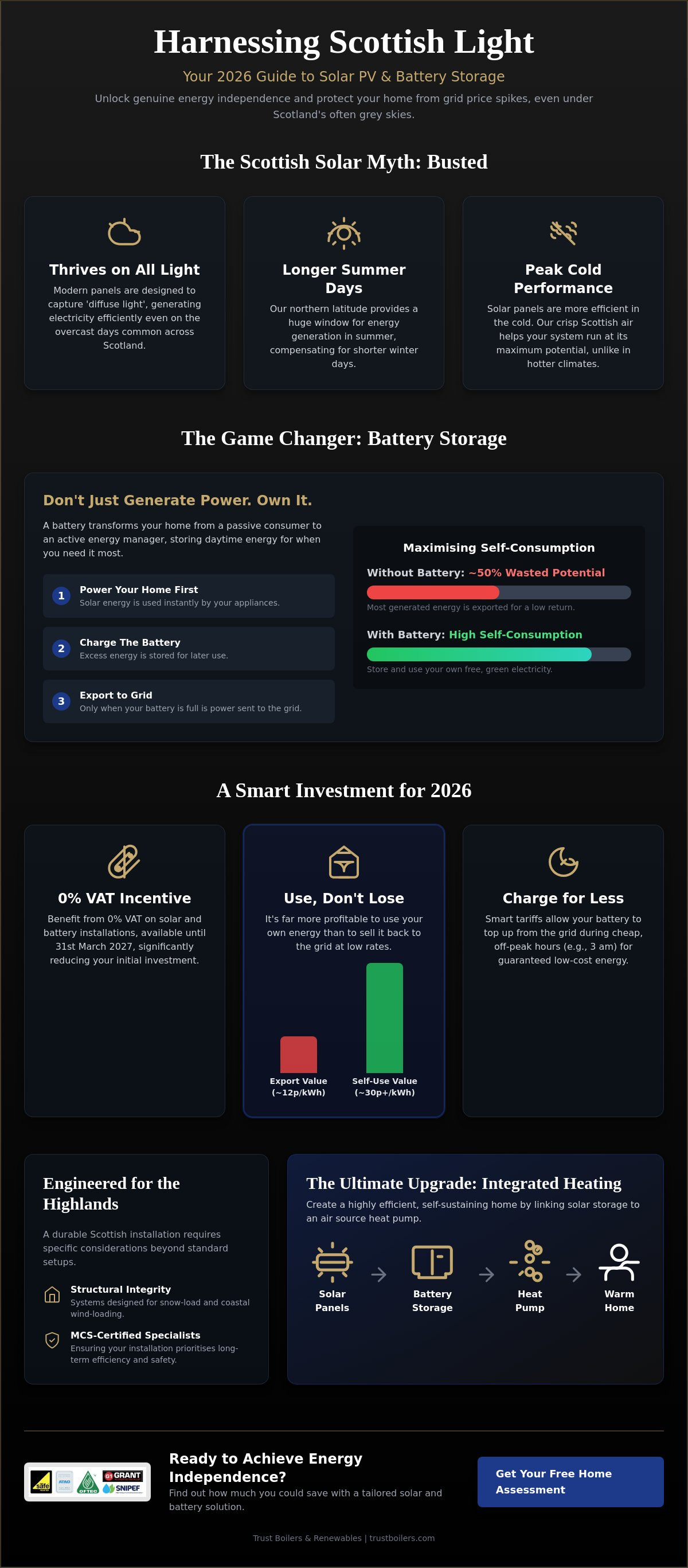
Designing an energy system for the North of Scotland isn’t the same as designing for the South. A generic, “one-size-fits-all” kit might work in London, but it won’t necessarily stand up to a winter in Keith or Huntly. When we plan an installation of solar PV and battery storage Scotland, we have to account for structural loads that many national providers simply overlook. In the Highlands, snow doesn’t just fall; it sits. Your roof must be assessed to ensure it can safely carry the weight of both the panels and a heavy layer of wet snow without compromising the timber integrity. Similarly, for our neighbours in coastal towns like Banff and Buckie, wind-loading is a critical factor. The mounting systems we use require extra precision and reinforced fixings to withstand the North Sea gales that can rattle a standard, southern-spec installation. For those managing more isolated properties, our dedicated guide to solar panels for rural homes Scotland explores the specific challenges and solutions for off-grid and remote locations in greater detail.
Beyond the physical build, the technical certification is just as important for your peace of mind. Ensuring your installer is MCS (Microgeneration Certification Scheme) certified is non-negotiable. This isn’t just a badge of quality; it’s a requirement for connecting to the Scottish grid and the only way to guarantee you remain eligible for export payments. If you’re ready to see how a bespoke, weather-proof setup would look on your roof, you can book a specialist solar PV and battery storage assessment with our local team today.
While a 35-degree south-facing roof is often called the “gold standard,” it isn’t the only path to success in Moray. In fact, an East-West split system is often better for modern working families. By placing panels on both sides of your roof, you capture the morning sun as the house wakes up and the evening sun as you’re making dinner. This provides a smoother, day-long power curve that matches your actual lifestyle better than a midday south-facing peak. To handle shading from the tall trees or local landmarks common in rural areas, we utilise power optimisers. These devices ensure that if one panel is caught in a cloudy patch or a shadow, the rest of the system continues to perform at its maximum capacity. Homeowners in the region who want to separate fact from fiction before committing will find our resource on solar panels Moray myths and the realities of local energy generation particularly useful for setting accurate expectations.
Selecting a battery isn’t just about picking the biggest unit available; it’s about matching the kWh storage to your household’s actual overnight baseload. We find that modular battery systems are a favourite amongst Scottish homeowners because they allow for sensible future-proofing. You can start with a smaller capacity and simply add more “stackable” units if you later install an electric vehicle charger or a heat pump. One protective measure we always insist on is the location of the battery. Whilst it might be tempting to tuck it away in a loft, Scottish winters are far too cold for that. Batteries perform best in temperature-controlled environments like a utility room or an insulated garage, ensuring the chemical cells stay efficient and achieve their full expected lifespan.
We view a high-quality installation of solar PV and battery storage Scotland as more than just a way to lower your electric bill. It’s the engine room of a modern, low-carbon home. By generating your own power, you’re creating the foundation for a sustainable lifestyle that doesn’t rely on the fluctuating costs of the National Grid. The true magic happens when you connect this electrical engine to your heating system. Integrating solar with Air Source Heat Pumps allows you to heat your home using the very energy you’ve captured from the sky, significantly reducing the running costs of your thermal system.
Our team brings a unique perspective to renewable energy. Because we live and work amongst you, from Fraserburgh to Elgin, we understand the specific demands of a Scottish property. We don’t just “fit and forget.” We design systems that are built to last, backed by a “Peace of Mind” guarantee that combines your installation with our dedicated care plans. This long-term commitment ensures your system remains as efficient in year ten as it was on day one. It’s about providing the stability you need to manage your home with confidence.
A well-designed home should function as a single, efficient ecosystem. One way we achieve this is through “Power Diverters.” These clever devices detect when your battery is full and your home’s immediate needs are met; they then redirect any remaining surplus to pre-heat your hot water tank. It’s a simple way to turn excess light into a hot bath. Additionally, a battery serves a vital role in protecting your equipment. It can “buffer” the high starting current required by a heat pump, preventing sudden surges from the grid and ensuring a smoother operation. For many in rural Aberdeenshire, this is the final step in creating a truly off-gas grid home that is both warm and affordable.
Whether you’re in Peterhead, Huntly, or Buckie, having a local specialist matters. Our deep background in Boiler Installation Aberdeenshire gives us a distinct advantage. We aren’t just electricians; we’re heating system designers who understand how water, heat, and electricity must work in harmony. When you book a local survey with us, you can expect a “Reliable Guardian” service. We’ll walk through your property, assess your roof’s integrity, and provide a methodical plan that prioritises your home’s long-term health. We take the time to do things correctly the first time, reinforcing our commitment to quality and your financial well-being.
You now have a clearer picture of how modern technology turns our unique Scottish climate into a reliable, year-round power source. By combining high-efficiency panels with smart storage, you aren’t just lowering your monthly outgoings; you’re shielding your household from the unpredictability of the national energy market. We’ve seen that success in the North depends on robust engineering and a system designed specifically for our local environment, from snow-load capacity to wind-resistant mountings.
Investing in solar PV and battery storage Scotland is a practical step toward long-term stability and financial protection. As local specialists serving the Highlands and Moray, we’re here to ensure your transition to renewable energy is smooth and secure. Our MCS Certified installers prioritise your home’s safety and structural integrity, whilst our comprehensive care plans offer the ongoing support needed for true peace of mind. You don’t have to navigate these technical choices alone.
Ready to transform your home into its own power station? Book your free local solar survey with Trust Boilers & Renewables today to discover exactly what is possible for your property. It’s time to stop worrying about grid price spikes and start looking forward to a more self-sufficient, sustainable future.
Solar panels remain active throughout the Scottish winter because they generate electricity from light rather than direct heat. While shorter daylight hours and lower sun angles reduce the total output compared to summer, modern high-efficiency panels still capture diffuse light on overcast days. This winter generation is often enough to cover your home’s “baseload” power needs, helping to keep your bills lower even during the darkest months of the year.
The total investment for a solar PV and battery storage Scotland system varies based on your property’s energy demand and the storage capacity you require. Factors such as roof orientation, the number of panels, and the battery’s kWh rating all influence the final cost. It is also important to consider the 0% VAT rate available until 31 March 2027, which offers a significant saving on the total installation compared to previous years.
Installing solar panels on a listed building or within a conservation area usually requires Listed Building Consent from your local council. While permitted development rights were relaxed in 2024 to encourage renewable energy, these rights often don’t apply to protected structures. We recommend contacting Aberdeen City Council’s planning department early in the process to discuss sympathetic mounting options that preserve the building’s character whilst meeting your energy goals.
Most modern lithium-ion solar batteries are designed to last between 10 and 15 years, depending on their usage and environment. Manufacturers typically provide warranties based on “cycles”, often guaranteeing 80% capacity after several thousand full charges. To maximise longevity, it’s vital to install the unit in a temperature-controlled space, as extreme Scottish winter temperatures in an uninsulated loft can degrade the storage cells faster over time.
Most domestic solar installations fall under “Permitted Development” and do not require formal planning permission in Aberdeenshire. However, specific rules apply regarding how far the panels protrude from the roofline and their proximity to the roof edge. If you live in a conservation area, a National Park, or a listed building, you must check with the local authority before proceeding, as stricter aesthetic regulations will likely apply to your property.
Standard solar systems are designed to shut down during a power cut to prevent electricity from leaking back into the grid and endangering engineers. However, if your system includes a battery with a dedicated “emergency backup” or “gateway” function, it can automatically disconnect from the grid and continue powering essential circuits in your home. This feature is particularly valuable for our clients in rural areas prone to storm-related outages. Homeowners in more isolated locations can find further guidance in our comprehensive resource on solar panels for rural homes in Scotland, which covers off-grid resilience strategies in depth.
Solar systems are remarkably low-maintenance because they have no moving parts to wear out. We suggest a simple visual inspection once a year to ensure the panels are clear of debris or heavy moss, and a professional health check every few years to verify the electrical connections. Modern monitoring apps allow you to track your system’s health in real-time, alerting you immediately if any component requires attention from a specialist.
You can certainly use your home battery to charge an electric vehicle, though it is often more efficient to use a “smart” EV charger that diverts excess solar power directly to the car. Since a typical EV battery is much larger than a home storage unit, your home battery acts as a secondary buffer. This helps you maximise your self-consumption of green energy and reduces the amount of expensive peak-rate electricity you pull from the grid.
FREE Download

Please complete the form below with your details, and one of our team members will contact you.
