

- Call our boiler installation team:
- 01261 394011
Please complete the form below with your details, and one of our team members will contact you.
What if the next winter storm rolling across the Highlands didn’t mean a nervous glance at your flickering lights or the dread of a skyrocketing utility bill? You’ve likely felt the sting of the July 2026 price cap, with electricity costs hitting 26.11p/kWh, and wondered when this cycle of volatility will finally end. It’s exhausting to manage a home when you feel at the mercy of a grid that’s both expensive and increasingly fragile. We understand that frustration because we see it every day in communities across Aberdeenshire and Moray. Finding reliable home energy independence solutions shouldn’t feel like a puzzle you have to solve alone.
This guide shows you exactly how to reclaim control over your own power and heating. You’ll discover how to shield your household from rising costs by creating a self-sustaining energy ecosystem that works even when the weather doesn’t. We’ll walk you through the practical steps of combining solar PV and battery storage with high-efficiency air source heat pumps. We’ll also help you navigate the current funding landscape, including how to secure up to £9,000 in grants to ensure your path to a warmer, more resilient home is as affordable as possible.
If you’ve spent any time looking at your utility bills lately, you’ll know that the 2026 energy market is a challenging place for Scottish homeowners. With the July 2026 price cap sitting at 26.11p/kWh, the traditional model of simply buying what you need from the grid has become a significant financial burden. What Does Home Energy Independence Mean? In the simplest terms, it is the transition from being a vulnerable end-user to a self-sufficient producer. It’s about your ability to generate your own clean electricity, store it safely, and manage exactly how it’s used within your four walls.
For most of our clients in rural Aberdeenshire or the Highlands, this doesn’t necessarily mean cutting the cord entirely. There’s a vital distinction between being “off-grid” and being “grid-neutral.” Going off-grid is often impractical and expensive; staying connected whilst implementing home energy independence solutions allows you to maintain a safety net. You can still pull from the grid during a dark December week, but you can also sell your excess solar power back during the summer. It turns your home into a micro-power plant that balances its own books.
Resilience is the other side of the coin. If you live in a coastal town or a remote glen, you’re likely familiar with the anxiety of winter storms. Grid-neutral systems with battery backup provide a “Reliable Guardian” for your household. When the local network fails due to high winds or snow, your stored energy keeps the lights on and the heat pump running. It’s about more than just pennies; it’s about the peace of mind that comes from knowing your home can look after itself.
The days of being a passive consumer are over. Smart meters and sophisticated time-of-use tariffs, such as Octopus Flux with its peak export rates of 29.32p/kWh, have completely changed the landscape. You can now organise your home to charge its batteries when prices are low and export power when the grid is desperate for it. This is particularly relevant in the North of Scotland, where the shift away from oil and gas is accelerating. Since the New Build Heat Standard prohibited direct emission heating in April 2024, we’ve seen a massive surge in households looking for “set and forget” systems that manage this complexity automatically.
Achieving independence is as much about your bank balance as it is about your fuse box. By reducing your reliance on imported energy, you create a shield against global market volatility. You don’t have to worry about the next geopolitical crisis because your roof is doing the heavy lifting. This economic protection is a favourite goal for families looking to lock in their outgoings for the next twenty years.
At its core, true home energy independence is a combination of self-generation and smart thermal management that ensures your property remains comfortable and affordable regardless of external market conditions.
Generating your own electricity is a powerful first step toward self-sufficiency, but it’s only one part of a truly resilient home. To reach the level of autonomy required in the 2026 market, we recommend a coordinated approach amongst three key technologies. This combination, often referred to as The Independence Triad: Solar PV, Battery Storage, and Heat Pumps, ensures that you aren’t just making power. You’re storing it and using it to eliminate your biggest household expenses. When these systems work in harmony, they provide a level of stability that a single technology simply cannot match.
Solar PV panels act as the primary engine for your home energy independence solutions. They harvest clean energy even on the overcast days common in Aberdeenshire and Moray. However, the real magic happens when that generation is paired with a storage system and a high-efficiency heating load. This setup allows you to stop worrying about the fluctuating prices of the National Grid and start relying on the infrastructure you own. It’s a shift from being a customer to being a guardian of your own energy security.
If you install solar panels without a battery, you’ll likely find yourself exporting a large portion of your energy to the grid during the day for around 15p/kWh. You then have to buy it back in the evening at the standard rate of 26.11p/kWh. This gap is why we view solar PV and battery storage Scotland as a single, inseparable unit. A battery acts as your personal “bank,” holding onto the energy you’ve generated whilst the sun was up so you can use it to power your lights, appliances, and heating after sunset. It maximises your self-consumption and ensures that every watt you produce stays within your home, where it’s most valuable.
Heating accounts for the vast majority of energy consumption in a typical Scottish property. This is why air source heat pumps are the essential third component of the triad. They replace old oil or gas boilers, using the electricity from your solar panels and batteries to heat your home with incredible efficiency. For every 1kW of electricity an ASHP uses, it typically provides 3 to 4kW of heat. This ratio is far superior to any fossil fuel system.
By integrating your heat pump with a smart thermal store, you can even “dump” excess solar energy into your hot water tank during peak generation hours. This effectively turns your water cylinder into a secondary battery. If you’re curious about how these technologies could fit into your specific property, we can help you with a bespoke system design tailored for the local climate.
Will solar panels actually work in the grey, overcast skies of Peterhead or Elgin? It’s a question we hear frequently from concerned homeowners. The short answer is yes. In fact, our northern climate offers some surprising advantages for home energy independence solutions. It is a common misconception that solar panels require blistering heat to function. In reality, solar cells are semiconductors, and like most electronic components, they perform most efficiently when they stay cool. The crisp, breezy conditions in Northern Scotland prevent panels from overheating, often leading to better performance per watt than on a sweltering day in the south of England.
To ensure your system remains a “Reliable Guardian” during the darker months, we focus on specialised design for the Scottish winter. Low sun angles require a different approach to panel orientation. We often utilise bifacial panels, which harvest light from both sides. These are particularly effective when there is frost or light snow on the ground, as they catch the reflected light from below. Similarly, modern air source heat pumps are specifically engineered to thrive in sub-zero temperatures. Even when the mercury drops well below zero in the Highlands, these systems continue to extract warmth from the outside air to keep your home at a steady, comfortable temperature.
If the grid goes down during a winter gale, a standard solar setup usually shuts off for safety. However, by specifying a battery system with “Island Mode”, your home can effectively isolate itself from the network. This allows you to keep essential circuits running whilst your neighbours are in the dark. It’s a vital layer of protection for rural properties where repair crews might take longer to reach. During these periods, you can manage your energy priorities, ensuring that your heat pump and fridge take precedence over non-essential appliances. We always advise a “fabric first” approach alongside these installs; high-performance insulation ensures that the heat your pump generates stays inside your home.
Consider a traditional granite home in rural Moray that recently moved away from an expensive, unpredictable oil boiler. By installing the Independence Triad, the owners eliminated their reliance on fuel deliveries and fluctuating market prices. A typical 4kW solar array in Aberdeen can still generate significant power during overcast days, providing enough electricity to cover base loads and contribute to the heating system.
To maintain this level of self-sufficiency, many local homeowners choose boiler and ASHP care plans. These plans provide the ongoing specialist support needed to ensure your investment remains efficient and safe for the long haul. It’s about building a system that doesn’t just work today, but continues to protect your financial health for decades to come.
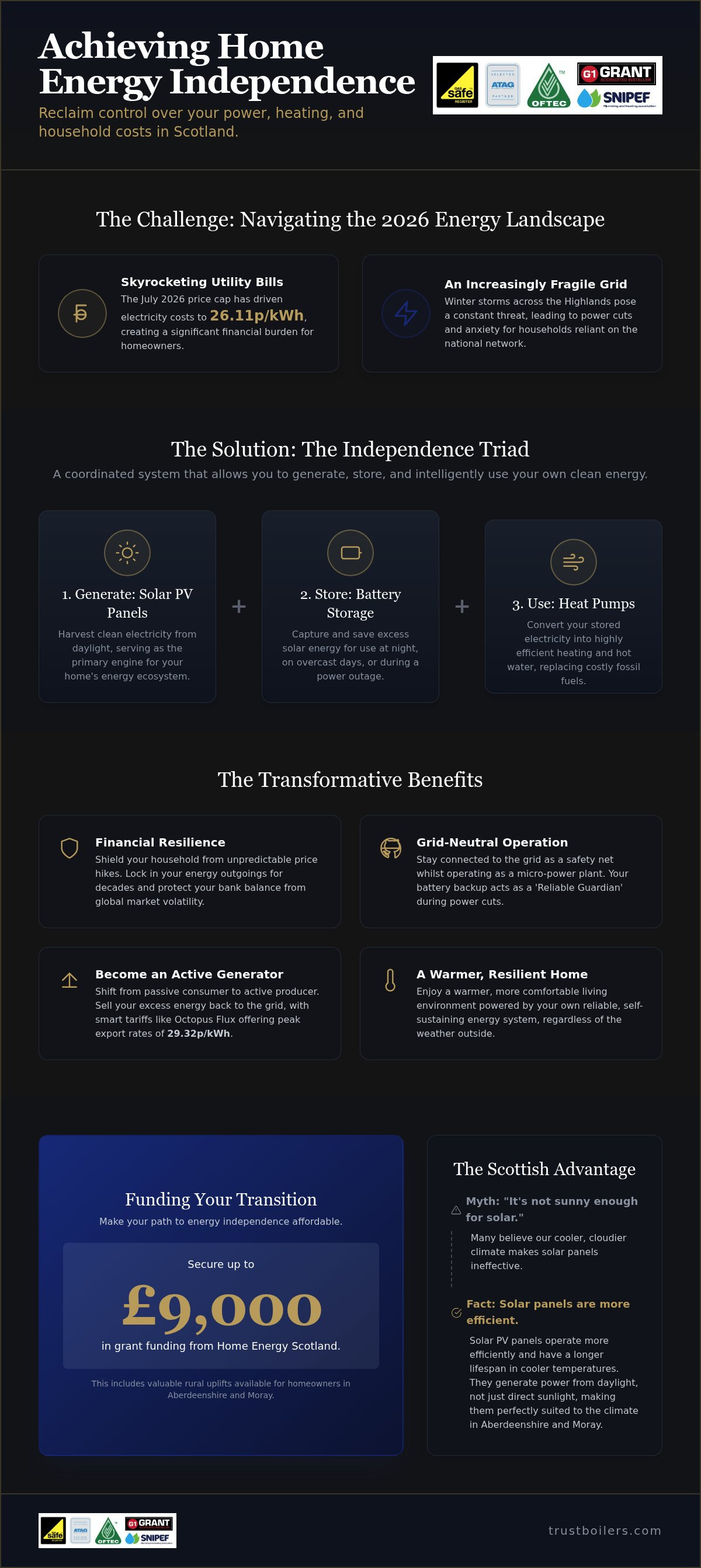
How do you move from the planning stage to a fully commissioned system without it becoming a financial burden? Whilst the initial capital investment for home energy independence solutions can seem high, the Scottish government provides some of the most robust support in the UK. However, the funding landscape has shifted significantly as of July 2026. Understanding exactly what you’re entitled to is the first step toward securing your home’s future and ensuring your investment pays for itself as quickly as possible.
To access these funds, you must follow a logical, step-by-step process. First, you’ll need a professional energy assessment and a valid Energy Performance Certificate (EPC). This document acts as your baseline, proving that your property is suitable for the technologies you want to install. To see how specialist consultants approach the planning stage, check out Madison May Consulting Ltd. Second, check if you qualify for the rural uplift. If your home is in a remote part of the Highlands or islands, you could be eligible for an additional £1,500 in grant funding. Finally, always ensure you use MCS-accredited installers. Without this accreditation, your project won’t comply with grant requirements, and you could find yourself footing the entire bill.
The Home Energy Scotland (HES) scheme remains the primary source of support. For air source heat pumps, owner-occupiers can receive a grant of up to £7,500. For those in rural areas, this increases to £9,000. An optional interest-free loan of up to £7,500 is also available to cover remaining costs. It’s vital to note that as of July 2026, HES funding is no longer available for solar PV or battery storage. However, you can still benefit from the 0% VAT rate on these installations until March 31, 2027. For a deeper breakdown of these changes, see our renewable energy grants Scotland guide.
The “independence ROI” has never been more attractive. With the electricity price cap at 26.11p/kWh, the average annual savings for a solar and battery system in Scotland reached £2,340 in early 2026. This brings the average payback period for a 6kW system down to just 6.8 years. Beyond the monthly savings, these systems significantly boost your property’s resale value. In a market where energy efficiency is a top priority for buyers, a home that is shielded from the “poverty trap” of inefficient heating is a highly desirable asset. Similarly, ensuring your home is prepared for all stages of life is a wise investment; HomeSafe Living Solutions specialises in professional home modifications that support long-term accessibility and independence.
To protect this return on investment, annual maintenance is essential. It’s a favourite way for our clients to ensure their systems continue to operate at peak efficiency for decades. If you’re ready to see how much you could save, we can provide a detailed funding assessment for your property.
Transitioning to a self-sufficient home is a significant undertaking. One of the most common mistakes we see is homeowners trying to coordinate separate contractors for solar panels, battery storage, and heating systems. This often leads to fragmented communication and systems that don’t talk to each other effectively. At Trust Boilers & Renewables, we believe that true home energy independence solutions require a unified approach. By choosing a local, multi-disciplinary specialist, you ensure that every component of the Independence Triad is designed to work in perfect harmony, specifically for the unique demands of the Scottish climate.
Our team takes a holistic view of your property. We don’t just install hardware; we design bespoke systems for homes in Aberdeen, Peterhead, and across the North. This comprehensive method ensures that your solar generation perfectly matches the demands of your air source heat pump. We handle the technical complexities so you don’t have to, providing a seamless path from your initial enquiry to a fully commissioned, grid-neutral home.
While our expertise is focused on the North of Scotland, we recommend that readers in other regions seek out similar specialist providers; those in the South West can visit Carbon Saving Group for expert renewable energy services across Devon and Cornwall.
We serve communities from Fraserburgh to Elgin and throughout the wider Highlands with a commitment to the highest professional standards. As MCS-accredited installers, we provide the consumer protection and technical assurance you need to invest with confidence. Our extensive experience in new build plumbing and heating gives us a unique advantage when designing retrofit systems. We understand the “bones” of Scottish properties, allowing us to anticipate challenges that a generalist installer might miss. This specialist knowledge is what makes us a Reliable Guardian for your home’s long-term health.
Taking the first step shouldn’t be stressful. We manage the heavy lifting, including the complex paperwork for grant applications and necessary DNO notifications to the local network operator. Once your system is live, our involvement doesn’t end. We offer dedicated Air Source Heat Pump Care Plans and support for your solar PV panel and battery storage to monitor performance amongst the changing Scottish seasons. These plans ensure your equipment remains efficient and your warranties stay valid for the long haul. We invite you to book a local energy survey with one of our specialists to begin your own journey toward total energy freedom. It’s time to stop worrying about the grid and start trusting in your own home’s potential.
The transition to a self-sufficient home is no longer just a trend; it’s a practical necessity for anyone living in the North of Scotland. By combining high-efficiency solar generation with smart battery storage and modern heat pumps, you can effectively shield your family from grid volatility. We’ve seen how the 2026 market rewards those who take proactive steps to manage their own power. Whether you’re in a remote Highland glen or a coastal town in Moray, these home energy independence solutions provide the stability and peace of mind you deserve.
As MCS Accredited Installers and specialists in Scottish rural energy, we pride ourselves on being your “Reliable Guardian” for the long term. Our comprehensive care plans ensure your systems stay at peak performance whilst you enjoy lower monthly outgoings. If you’re ready to stop worrying about rising costs and start generating your own warmth and light, we’re here to guide you through every grant application and technical choice. Start your journey to energy independence with a local expert survey from Trust Boilers & Renewables and discover the difference that specialist local expertise makes to your home’s resilience.
Yes, it’s absolutely possible to achieve a high degree of self-sufficiency. Whilst total disconnection from the grid is rare and often impractical, most Scottish homeowners aim for “grid neutrality.” This is where you generate as much energy as you consume over the course of a year. Using home energy independence solutions like the Independence Triad ensures your home remains powered and comfortable even during the darker months by balancing generation, storage, and efficient heating.
Industry data for July 2026 shows that a combined 4kW solar system with a 5kWh battery typically costs between £9,000 and £13,000. If you’re only looking at battery storage, a 10kWh unit generally ranges from £4,000 to £6,000 plus installation costs. These figures are market averages and will vary based on the specific requirements of your property and the complexity of the system design.
Solar panels remain effective throughout the winter because they harvest daylight, not just direct sunlight. In fact, the cooler temperatures found in Aberdeenshire and Moray actually improve the efficiency of the solar cells compared to sweltering heat. Whilst generation is naturally lower in December than in June, a well-designed system paired with battery storage ensures you maximise every available watt of light to power your home.
You can certainly add battery storage to an existing solar setup. This is usually done through “AC-coupling,” where a separate battery inverter is installed alongside your current equipment. It’s a popular way to upgrade older arrays into modern home energy independence solutions, allowing you to store excess power during the day that you would otherwise have been forced to export to the grid.
By default, most solar systems shut down during a power cut to protect engineers working on the lines. If you want your home to stay powered during a local network failure, you must specify a system with “Island Mode” or an Emergency Power Supply (EPS). This allows your battery to isolate your home from the grid and keep your essential circuits, like lighting and your fridge, running safely.
Yes, rural homeowners in the Highlands and parts of Aberdeenshire are often eligible for a “rural uplift” grant. For example, the standard Home Energy Scotland grant of £7,500 for an air source heat pump increases to £9,000 for properties in eligible rural areas. It’s important to verify your specific postcode’s eligibility with Home Energy Scotland before you begin your project to ensure you don’t miss out on this extra funding.
Modern renewable systems are built for long-term reliability. You can typically expect a high-quality lithium battery to last between 10 and 15 years, whilst an air source heat pump has an expected lifespan of 15 to 20 years. We always recommend regular servicing through a specialist care plan to ensure these components continue to operate at peak efficiency and that your manufacturer warranties remain valid for the long haul.
Most installations fall under “Permitted Development” and don’t require full planning permission. However, specific rules apply if your home is a listed building or located within a conservation area. For heat pumps, there are also regulations regarding the noise levels and the distance the unit sits from your neighbour’s boundary. We always advise checking with your local council’s planning department to ensure your specific project is fully compliant.
FREE Download

Please complete the form below with your details, and one of our team members will contact you.
