

- Call our boiler installation team:
- 01261 394011
Please complete the form below with your details, and one of our team members will contact you.
Trust Boilers
Have you ever looked at a grey, drizzly morning in Elgin and wondered if solar panels are actually a sensible choice for the north of Scotland? It’s a question we hear often, and it’s completely understandable given our reputation for unpredictable weather. You might feel that without constant sunshine, your investment in solar PV and battery storage Moray won’t deliver the savings you need to offset those rising rural energy bills or protect you from frequent Highland power cuts.
We agree that a generic approach doesn’t work here; you need a system designed for our specific latitude. This guide will show you how to harness Moray’s unique daylight hours to slash your monthly outgoings and achieve genuine power security. We’ll walk you through the 2026 landscape, including the 0% VAT rate on installations and how to choose the right battery size for a Scottish winter. By the end, you’ll know exactly how to create a reliable, integrated solution that keeps your home running whilst the rest of the grid struggles.
Living in the north of Scotland has always required a certain level of resilience. For years, many of us have accepted high energy bills and the occasional winter blackout as an unavoidable part of Highland life. However, the energy landscape is shifting rapidly. Local homeowners are now moving away from being passive consumers and becoming ‘prosumers’ who produce, store, and manage their own clean electricity. By installing solar PV and battery storage Moray residents are essentially building their own private home power plants, providing a level of security that traditional suppliers simply cannot match.
If you live in a rural pocket like Speyside or the outskirts of Keith, you likely know the frustration of being off the gas grid. Relying on oil or LPG deliveries means you’re vulnerable to volatile market prices and delivery schedules that you cannot control. It’s an expensive way to heat a home. Beyond the cost, there’s the pressing issue of reliability. Our exposed coastal and highland locations often face power cuts during the storm season. A battery system acts as a vital safety net in these moments. It keeps your lights on and your essential appliances running whilst the main grid is down; it offers the peace of mind that comes from knowing your home is protected.
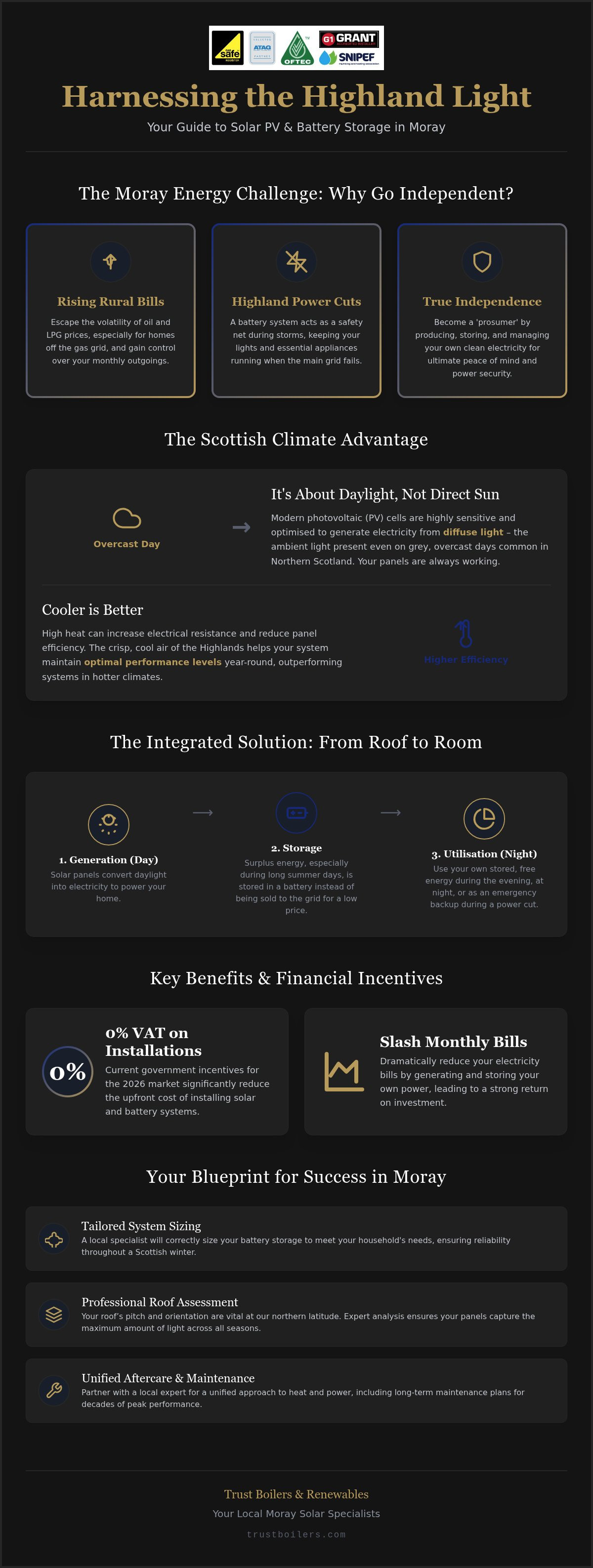
This setup involves two distinct technologies working in perfect harmony to power your life. Solar PV is a technology that converts daylight, not just direct sunlight, into electricity. This is a crucial distinction for our climate. Even on those flat, grey days we often see in Buckie or Banff, your panels are still generating power. Instead of letting excess energy spill back to the grid during the day, home energy storage systems capture that power for you to use in the evening.
Professional design is the secret to making this work in Northern Scotland. We don’t believe in a one-size-fits-all approach. Every house in Elgin or Keith has a different roof pitch and orientation. By choosing a system tailored to your specific location, you ensure that your solar PV and battery storage Moray investment performs at its peak for decades. It’s about doing the job correctly the first time so you can enjoy the long-term benefits of a lower carbon footprint and significantly reduced monthly outgoings.
One of the most frequent concerns we hear from homeowners in Elgin or Keith is whether our northern weather provides enough “fuel” for a solar system. It’s a valid question. If you’ve spent a winter in Moray, you know that direct sunlight can feel like a rare luxury. However, the performance of a modern system doesn’t rely on the heat of the sun; it relies on daylight. By understanding the science of light at our latitude, it becomes clear why solar PV and battery storage Moray installations are becoming a standard feature of resilient Scottish homes.
Modern photovoltaic cells are designed to be incredibly sensitive. They don’t require a cloudless sky to generate electricity. Instead, they utilise “diffuse” light, which is the sunlight that has been scattered by clouds and the atmosphere. Even on a flat, grey Tuesday in Aberlour or a misty morning in Banff, your roof is still producing power. In fact, solar panels are actually more efficient in cooler temperatures. High heat can cause electrical resistance, but the crisp, cool air of the Highlands helps your system maintain optimal performance levels.
To make the most of this light, the design of your system is paramount. Because the sun sits lower in the sky at our northern latitude, the pitch and orientation of your roof play a significant role. A local specialist will ensure your panels are positioned to capture the maximum amount of light across the four seasons, rather than just relying on the peak of summer. If you’re curious about how your specific roof would perform, it’s worth asking a local expert for a tailored assessment.
If the panels are the engine, the battery is the fuel tank. During our long Moray summer days, where we can see over 17 hours of daylight, a standard home will often generate far more electricity than it can use at noon. Without storage, that surplus is sent back to the grid for a minimal return. A battery allows you to hold that “Scottish Summer” energy to power your home through the evening and night. This significantly increases your self-consumption rates and reduces your reliance on expensive grid power.
The battery also provides a strategic advantage during the darker winter months. Whilst solar generation is lower in December, smart systems can be programmed to “peak shave.” This means your battery can charge from the grid during the night when electricity rates are at their lowest, then discharge that cheap power during the expensive breakfast and dinner peaks. Following the Energy Saving Trust advice on battery storage, integrating this technology ensures your home remains efficient and cost-effective every day of the year, regardless of the cloud cover.
Investing in solar PV and battery storage Moray isn’t just about “doing your bit” for the planet. It’s a calculated financial strategy designed to protect your household from the volatility of the global energy market. Beyond the immediate reduction in monthly bills, these systems add tangible value to Scottish properties. Homebuyers in Elgin and the surrounding areas are increasingly looking for energy-efficient features that offer long-term security; a professionally installed system makes your home more attractive and resilient in a competitive market. When you consider the rising costs of traditional fuels, the transition to self-generation becomes a matter of common sense.
The funding landscape for renewables has evolved significantly over the last few years. Whilst the standalone grant for solar was withdrawn in 2024, there are still robust ways to finance your project. The Home Energy Scotland scheme remains a primary route, offering interest-free loans to help spread the cost of installation. Additionally, the 0% VAT rate on energy-saving materials remains in place until March 31, 2027, representing a direct saving on your total project cost.
For those in specific circumstances, the Moray Council Energy Efficient Scotland: Area Based Scheme provides targeted support to reduce fuel poverty in our local communities. It’s also worth noting the Warm Homes Loan Scheme, which launched in September 2026 to provide government-subsidised bank loans for solar and batteries. To access these incentives and ensure you’re eligible to claim payments for the energy you export, you must use an MCS-certified local installer. Combining solar with an air source heat pump can often unlock higher levels of support, as current funding models prioritise whole-home heat decarbonisation.
Your return on investment depends largely on how much of your generated power you actually use. This is where battery capacity becomes critical. By storing energy during the day to use at night, you avoid buying expensive units from the grid during peak evening hours. You also benefit from the Smart Export Guarantee (SEG). This scheme requires energy suppliers to pay you for any surplus electricity you send back to the grid, with rates in 2026 ranging from 3p to over 20p per kWh depending on your chosen tariff.
Typical ROI periods in Scotland currently fall between 7 and 15 years. This timeframe is influenced by your household’s unique usage patterns and the specific orientation of your roof. For a more detailed breakdown of performance data across the country, you can explore our Solar PV and Battery Storage Scotland pillar. Ultimately, the goal is to reach a point where your system has paid for itself, leaving you with decades of virtually free electricity and the peace of mind that your home is powered by a reliable, local source.
Selecting the ideal setup for a property in Elgin or Lossiemouth isn’t as simple as picking panels from a brochure. It’s a precise engineering task that must account for the reality of our northern environment. For a typical 4-bedroom home in Moray, the goal is to balance your daily generation with enough storage to bridge the gap between sunset and sunrise. This requires a careful look at your roof’s structural integrity; we must ensure it can handle the combined weight of the mounting system and the panels, especially when you factor in the additional “snow load” we often experience during a Highland winter.
A bespoke survey is essential for homes in coastal spots like Buckie or Fraserburgh, where salt-mist resistance is a priority for the longevity of your equipment. We evaluate potential shading from nearby buildings or the rolling Moray landscape that might clip your peak generation hours. Oversizing your PV array is often a smart move in Scotland because it allows you to harvest a higher volume of energy during those long periods of diffuse, overcast light. By installing more panels than your inverter’s base rating might suggest, you ensure that even on a flat, grey afternoon, your system is still producing enough to keep your battery topped up.
While older lead-acid batteries were once common, modern lithium-ion (LiFePO4) storage is now the gold standard for residential solar PV and battery storage Moray installations. These units are more compact, safer, and offer a significantly longer lifespan. A premium lithium battery should provide upwards of 6,000 cycles. This means the unit can be fully charged and discharged every single day for over 15 years while still retaining the vast majority of its original capacity. It’s an investment in stability that pays off over the long haul.
Future-proofing is the final piece of the puzzle. Your energy needs might grow if you decide to add an electric vehicle or an air source heat pump in the coming years. We recommend choosing a modular battery system that allows you to add more storage capacity later without replacing the entire unit. To keep your home’s energy hub running at peak efficiency, local maintenance and boiler care plans should include your solar inverter as part of your annual safety and performance check. If you’re ready to see how a tailored system could work for your property, contact our design team for a detailed home assessment.
Choosing a partner for your home’s energy transition is a decision rooted in trust. It’s not just about who can bolt panels to a roof; it’s about who will be there in five years if a storm rattles the mounting system or a software update needs a manual tweak. At Trust Boilers & Renewables, we pride ourselves on being a dependable neighbour for residents across Elgin, Buckie, and Keith. Our ‘Reliable Guardian’ approach means we don’t just complete a task and disappear. We take a long-term view of your home’s health, ensuring that your solar PV and battery storage Moray investment remains as efficient in its tenth year as it was on day one.
One of the most significant advantages of working with us is our ability to provide a unified solution for both heat and power. Many contractors specialise in only one area, leaving you to manage the complex communication between different trades. We bridge that gap. By integrating your solar panels with air source heat pumps, we can programme your system to use surplus energy to pre-heat your hot water cylinder. This ‘thermal storage’ acts like a second battery, further reducing your reliance on the grid and lowering your running costs. It’s a sophisticated way to manage your home’s environment that only a specialist with deep roots in both plumbing and renewables can offer.
Our team’s extensive experience in Aberdeenshire boiler installation gives us a unique perspective on system design. We understand the structural demands of Highland roofs and the intricacies of domestic wiring in older Moray properties. Whether we are working in Peterhead or Fraserburgh, our process is methodical and transparent. We begin with a design-led survey, move through a precise installation phase, and conclude with a comprehensive handover so you feel confident operating your new system. Our commitment doesn’t end at the finish line; our care plans provide ongoing support and maintenance to protect your peace of mind for decades to come.
Contact Trust Boilers for a bespoke Moray solar quote to start your journey toward energy independence.
Achieving energy independence is no longer a distant goal for homeowners in the north of Scotland. By harnessing the science of diffuse light and pairing it with smart storage, you can protect your household from rising costs and grid instability. We’ve explored how a correctly designed system for solar PV and battery storage Moray can deliver long-term financial returns whilst providing the peace of mind that your home remains powered through the toughest winters.
As local Moray and Highland specialists, we understand the specific demands of our climate. Our team of MCS Certified Installers brings a unique blend of expertise as integrated heating and renewable experts; we ensure your system works in perfect harmony with your property. Ready to take the first step toward lower bills and reliable power? Book a Free Local Solar Survey in Moray to discover the potential of your roof. The transition to clean, self-generated energy is an investment in your home’s longevity and your family’s comfort. We look forward to helping you make it a reality.
Yes, they generate power using diffuse daylight even when the sun is low in the sky. While output is naturally lower in December than in June, modern panels are highly efficient in the Highlands’ cool temperatures. Cool air actually helps maintain electrical performance by reducing resistance. A system designed for our specific latitude ensures you still capture enough light to contribute to your home’s needs throughout the entire year.
Savings depend on your household’s unique usage, but many homeowners see a significant reduction in grid reliance. By using solar PV and battery storage Moray, you avoid buying expensive peak-time electricity from the grid. With Smart Export Guarantee (SEG) rates in 2026 ranging from 3p to over 20p per kWh, you also earn money for surplus energy. Most Scottish systems currently achieve a full return on investment within 7 to 15 years.
Most roofs in Elgin, Buckie, or Keith are suitable, provided they’re structurally sound and have minimal shading. While south-facing is ideal, east and west-facing roofs also perform well in our climate. We conduct a bespoke survey to assess the pitch and orientation of your property. We also ensure your roof can handle the specific snow and wind loads common in coastal and Highland environments to guarantee long-term safety.
If your system includes a backup gateway, your battery will automatically provide power to essential circuits during a grid failure. This is a vital feature for exposed rural areas in Moray prone to storm-related outages. It ensures your lights, fridge, and internet stay active whilst the grid is down. Without this specific backup configuration, standard solar inverters will shut down during a power cut to protect engineers working on the lines.
Modern Lithium-ion (LiFePO4) batteries are built for longevity and typically last between 10 and 15 years. Most premium units are rated for 6,000 cycles or more, meaning they can be charged and discharged daily while retaining the vast majority of their original capacity. Choosing a high-quality component ensures your system remains reliable. We include battery health checks as part of our ongoing maintenance plans for your long-term peace of mind.
Yes, you can retro-fit a battery to almost any existing solar array. This is usually done via a process called AC-coupling, where a separate battery inverter is installed alongside your current setup. It’s an excellent way to upgrade your home’s energy independence if you already have panels but find you’re exporting too much surplus to the grid. We can assess your current system to ensure the new storage integrates seamlessly.
While the standalone grant was withdrawn in 2024, other incentives remain. The 0% VAT rate applies until March 2027, and the Warm Homes Loan Scheme, launched in September 2026, offers government-subsidised bank loans up to £15,000. Additionally, the ECO4 scheme remains active until the end of 2026 for eligible low-income households. We help you navigate these options to find the most cost-effective funding route for your specific home and circumstances.
A standard residential installation of solar PV and battery storage Moray usually takes two to three days to complete. The first day involves erecting scaffolding and mounting the roof brackets and panels. The second day focuses on the internal electrical work, including the inverter and battery storage setup. We aim to minimise disruption to your daily routine and ensure your home is left clean and tidy once the system is commissioned.
FREE Download

Please complete the form below with your details, and one of our team members will contact you.
