

- Call our boiler installation team:
- 01261 394011
Please complete the form below with your details, and one of our team members will contact you.
What if the key to slashed energy bills in the North East wasn’t waiting for a rare Scottish heatwave, but simply making better use of the reliable daylight we already have? You’ve likely watched your monthly costs climb whilst wondering if those grey winter skies make renewable energy a wasted investment for your home. It’s a common worry; especially when grant schemes shift and technical talk about MCS accreditation feels like just another hurdle to clear. If you’re feeling uncertain about how panels perform during a Granite City winter, you aren’t alone.
We understand that you want a home that’s both warm and cost-effective. This 2026 guide simplifies the entire process of solar PV installation Aberdeenshire homeowners need to master. We’ll show you exactly how to plan a system tailored for our unique northern climate, ensuring you gain the long-term peace of mind that comes with lower bills and professional reliability.
We will walk through the current 0% VAT benefits, how to secure the best Smart Export Guarantee rates, and the practical steps to achieving energy independence using modern battery storage. By the end, you’ll have a clear, logical path toward a more sustainable and self-sufficient home.
Do people really think the North East is too dark for solar? It’s a common misconception that often stops homeowners from taking control of their energy bills. Many residents in Aberdeen and the surrounding shire assume that because we aren’t located in the South of France, a solar PV installation Aberdeenshire project won’t deliver a return. In reality, the 2026 energy landscape makes this the ideal time to invest. Modern technology has moved far beyond the need for constant, direct tropical sun to be effective.
Today’s panels are specifically engineered to capture diffuse light. This means they generate power even when the sky is blanketed in a familiar North East haar or heavy clouds. Because Renewable energy in Scotland has become a cornerstone of the national grid strategy, the hardware has adapted for our northern latitudes. With electricity prices remaining volatile through 2026, generating your own power isn’t just a green choice. It’s a protective financial shield for your household.
At Trust Boilers, we act as a proactive advisor and a reliable guardian for your home’s energy systems. We don’t just fit panels; we ensure your setup is robust enough to handle the coastal winds and long winters that define our region. We take a safety-first approach to ensure your investment provides peace of mind for the long haul.
Think about those endless summer evenings in Fraserburgh and Peterhead. Aberdeen actually receives around 1,450 hours of sunshine per year, which is the highest of any major Scottish city. During these months, your system can produce a significant surplus of energy. Interestingly, solar panels perform more efficiently in cooler temperatures. High heat can actually hinder performance, but our crisp Aberdeenshire air helps the cells maintain an optimal operating state whilst they work. Photovoltaic cells function by converting the energy within daylight into a flow of electricity through the movement of electrons, a process that continues even on the most overcast January afternoon.
For those living in rural pockets like Huntly or Keith, being off the gas grid often means relying on expensive oil or LPG. A solar PV installation Aberdeenshire provides a level of stability that traditional fuels simply can’t match. When you combine this with solar PV and battery storage Scotland solutions, you can store that daytime harvest for use during the evening. This setup effectively disconnects your daily life from the fluctuating prices of the national grid. It gives you total control over your home’s environment and secures your financial health against future market spikes.
How do you know which setup is actually right for your specific roof? Choosing a solar PV installation Aberdeenshire homeowners can rely on starts with a clear look at your household’s unique energy profile. You’ll need to check your annual electricity statement to see your total consumption in kilowatt-hours (kWh). If your family uses around 4,000 kWh a year, a standard 4kWp system is usually the logical starting point. For our specific climate, we always favour monocrystalline panels. They’re more efficient in the diffuse light we mentioned earlier and offer better longevity than older polycrystalline alternatives.
If your roof has dormers, chimneys, or nearby trees, shading can be a significant headache. A traditional string inverter works like a chain of fairy lights; if one panel is shaded, the performance of the whole string can drop. Micro-inverters solve this problem by letting each panel work independently. This ensures your system stays productive even when the winter sun is low on the horizon. The Energy Saving Trust guide to solar panels provides a brilliant baseline for these technical choices, but a local specialist can help fine-tune the details for your specific postcode.
A 4kW system is often the “sweet spot” for most three-bedroom semi-detached homes in towns like Inverurie or Ellon. However, if you’re planning to switch to an electric vehicle or have a larger family, a 6kW or 10kW system provides much-needed headroom. Over-sizing your array is often a smart move if you’re installing a battery, as it allows you to fill that storage even on shorter winter days. For those living in larger detached properties, our guide on solar panels for rural homes Scotland offers deeper insight into high-capacity setups.
Solar panels typically produce the most power when many families are out at work. Without a battery, that surplus energy is simply sent back to the grid. By adding storage, you capture that energy to use during the expensive evening peak. This “peak shaving” protects your bank balance from the highest utility tariffs. It’s particularly effective if you already have an air source heat pump, as it allows your solar harvest to contribute directly to your heating costs. If you’re ready to explore these options, looking into a professional solar pv panel and battery storage setup is a smart next step for total energy independence and long-term peace of mind.
Is your property truly ready for the weight and technical demands of a new energy system? Before any panels arrive on-site, a thorough assessment of your home’s structure and electrical health is vital for long-term safety. A solar PV installation Aberdeenshire project relies on more than just a clear view of the sky; it requires a roof and a consumer unit that are up to the task. We take a safety-first approach, ensuring every component of your home is prepared to support your transition to renewables.
This emphasis on structural and technical readiness is a hallmark of professional installers like MarGav Solar, who provide the consultancy needed to ensure every property is perfectly suited for solar technology.
Whilst south-facing roofs remain the gold standard for maximum generation, we often find that East-West splits are better for families who use most of their power in the mornings and evenings. An East-West configuration provides a consistent stream of power across the whole day rather than one large midday peak. For those in rural spots, shading from tall pines or even large stone chimneys can drastically reduce output. If your roof experiences significant shading, we’ll need to consider optimisers or micro-inverters to keep the system productive.
Your electrical consumer unit must also be modern enough to handle the bi-directional flow of energy. If you’re still using an old-style fuse box with rewirable fuses, an upgrade will likely be a necessary part of the project. This ensures your system can safely manage the input from your panels and the storage capacity of a battery. Checking the latest Home Energy Scotland grants and loans can help you understand if these necessary electrical or structural improvements can be supported as part of a wider energy upgrade.
A pitch of 30 to 40 degrees is ideal for catching the lower trajectory of the Scottish sun. This angle helps the panels capture maximum daylight whilst also encouraging snow to slide off during the winter months. If your roof pitch is shallower or steeper, the system will still function, but the annual yield might be slightly lower. We’ll always calculate these variables during your initial survey to give you an honest projection of your future savings.
Homes in Buckie, Banff, and the surrounding coastal towns often feature heavy traditional slate. These roofs require a specialist touch to ensure the mounting brackets don’t cause leaks or stress the older rafters. An MCS-certified surveyor must check the attic space to confirm the timber can support the additional load of the panels and mounting rails. In Aberdeenshire, most residential rooftop installations are considered permitted development, but if you live in a listed building or a conservation area in Aberdeen, you’ll require specific consent before your solar PV installation Aberdeenshire can begin.
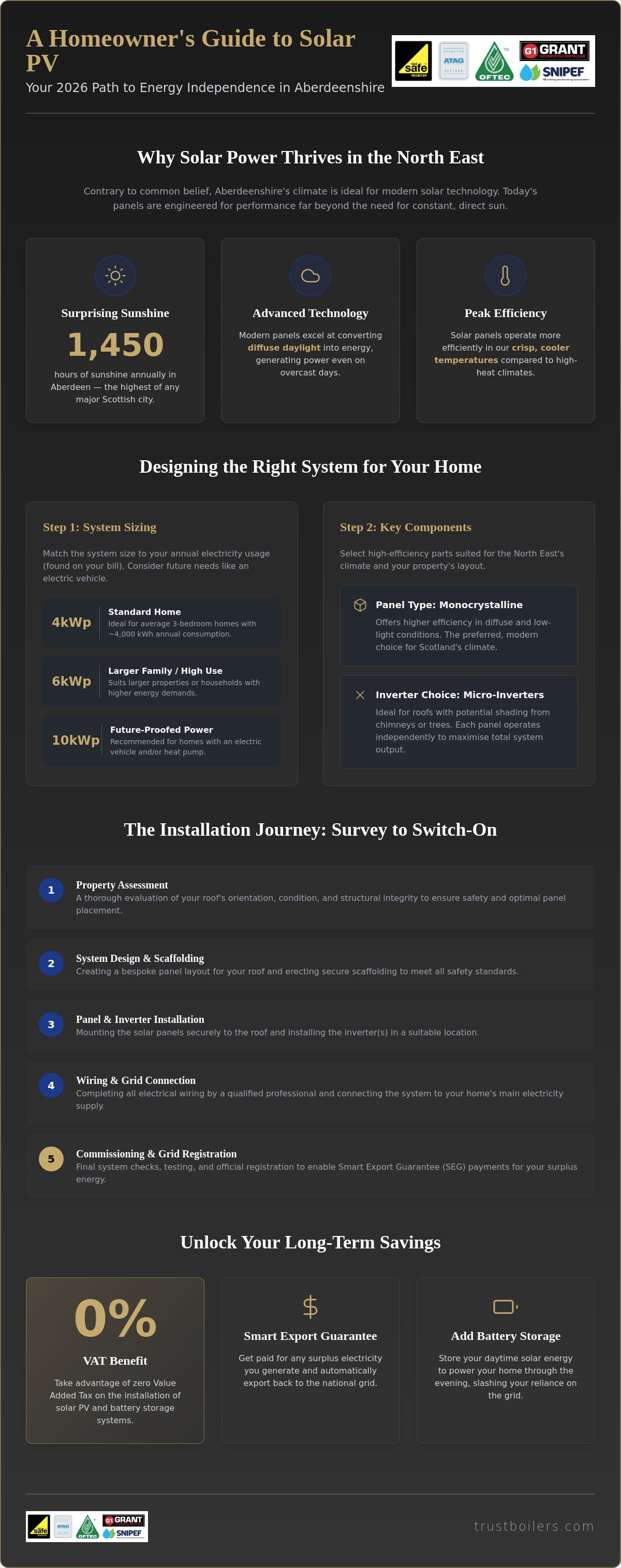
Wondering what actually happens once the van pulls up? We know that home renovations can feel intrusive, so we aim for a methodical, steady process that respects your space and your schedule. A solar PV installation Aberdeenshire project is typically completed in just five clear stages, designed to get you generating power as quickly and safely as possible. We don’t believe in rushed jobs; we believe in doing things correctly the first time to ensure your system’s longevity.
Most domestic installs take just one to two days. On the first morning, you’ll see the most activity as the scaffolding and external frames go up. You won’t need to worry about being without power for the duration of the build; we only need to turn off your electricity for a short period, typically one to two hours, whilst we update your consumer unit. We’ll always coordinate this with you in advance to ensure it doesn’t clash with your work or home life.
The final walkthrough is where your system truly comes to life. We’ll sit down with you to set up your monitoring app, which acts as your “Reliable Guardian,” showing you exactly how much energy you’re producing and saving in real-time. This is also the perfect time to clear up any lingering doubts. We often point our clients toward our guide on solar panels Moray to debunk common myths about winter performance that still circulate locally. Your MCS certificate is the final piece of the puzzle. You’ll need this vital document to register for Smart Export Guarantee (SEG) payments, allowing you to earn money for any surplus energy you export back to the grid.
How do you ensure your energy investment stays as efficient in year ten as it was on day one? Getting your solar PV installation Aberdeenshire project completed is a significant milestone, but the real work of maximising your return on investment (ROI) happens in the years that follow. By 2026, the financial case for solar has shifted from upfront grants to long-term generation benefits. With the 0% VAT rate on residential solar and battery storage confirmed until March 2027, the initial cost is already more manageable than in previous decades.
The most effective way to claw back your investment is through the Smart Export Guarantee (SEG). By choosing a supplier with competitive export rates, you can receive payments for every kilowatt-hour of surplus energy you send back to the grid. When combined with high self-consumption, many homeowners in the North East find their system pays for itself within five to ten years. We always advise our clients to treat their system as a long-term asset that requires a “Reliable Guardian” approach to maintenance and monitoring.
While the direct grant landscape has evolved, there is still significant support available through renewable energy grants Scotland programmes. As of 2026, funding from Home Energy Scotland has prioritised clean heating and insulation, but interest-free loans remain a vital tool for spreading the cost of battery storage systems. If you are planning to install an air source heat pump alongside your solar panels, you may also be eligible for the Boiler Upgrade Scheme (BUS) or enhanced rural uplift grants. These packages work best when designed together, ensuring your solar harvest directly offsets the running costs of your new heating system.
Living in a coastal region brings specific challenges. If you reside in Fraserburgh, Peterhead, or any of our seaside towns, salt air can lead to a fine crust forming on your panels over time. This build-up can subtly reduce your system’s efficiency by blocking daylight. A simple annual clean with deionised water is usually enough to keep your solar PV installation Aberdeenshire performing at its peak. You should also use your smartphone monitoring app to check for inverter faults or unexpected drops in generation; catching a small technical glitch early prevents it from becoming a costly repair later.
This proactive approach to maintenance is shared by family-run specialists like Jelvis, who emphasise that regular professional oversight is the best way to safeguard the performance of your electrical and heating systems.
A professional care plan ensures that your renewable hardware receives the same level of attention as a traditional boiler. Regular health checks provide the peace of mind that your system is safe, compliant, and generating the maximum possible savings. If you’re ready to see how solar can transform your home’s finances, you can book your Aberdeenshire solar survey with Trust Boilers today and take the first step toward true energy independence.
Transitioning to renewable energy is one of the most effective ways to protect your household from unpredictable utility costs. We’ve explored how modern technology thrives in the North East’s unique daylight and why integrating battery storage is the final piece of the energy independence puzzle. By following a methodical, safety-first approach to your solar PV installation Aberdeenshire, you can transform your roof into a reliable asset that provides financial stability for decades.
As a local Aberdeenshire family business, we take pride in acting as a reliable guardian for your home’s mechanical systems. Our MCS Accredited Installers are specialists in rural and off-grid renewable solutions, meaning we understand the specific structural and weather challenges of our region. If you’re ready to lower your monthly bills and take total control of your power, request your free, local solar PV survey in Aberdeenshire to get started.
There’s never been a more logical time to invest in your home’s longevity and performance. We look forward to helping you build a more sustainable and self-sufficient future for your family.
Most residential rooftop solar panels in Aberdeenshire are considered permitted development and don’t require a formal planning application. This applies as long as the panels don’t protrude more than 200mm from the roofline. However, if your home is a listed building or located within a conservation area, you’ll need to obtain specific consent from the council before starting work.
Homeowners with a typical 4kW system can expect to save between £1,000 and £1,800 annually on their electricity bills based on 2026 energy prices. Your total savings depend heavily on how much of the generated power you use within the home. Adding battery storage helps maximise these returns by allowing you to use your solar harvest during expensive evening peak hours.
Solar panels are perfectly compatible with the traditional slate roofs common across Moray and Banffshire. We use specialist stainless steel slate anchors that fit beneath the tiles to secure the mounting rails without damaging the stone. This ensures your roof remains completely watertight whilst providing a robust foundation for your new energy system.
A high-quality solar PV system is built for longevity; panels typically carry a performance warranty of 25 to 30 years. While the panels themselves are very durable, the inverter usually needs replacing after 10 to 15 years of service. Regular maintenance checks through a professional care plan will help ensure your system continues to operate at peak efficiency for decades.
MCS (Microgeneration Certification Scheme) accreditation is a mark of quality that ensures your system is installed to strict industry standards. It’s a vital requirement for any solar PV installation Aberdeenshire project because you cannot access Smart Export Guarantee (SEG) payments without an MCS certificate. It provides you with the peace of mind that your installer is technically competent and fully insured.
You can certainly add a battery to your existing system at a later date, though it’s often more cost-effective to include it during the initial build. The current 0% VAT rate applies to both solar panels and standalone battery storage until March 2027. Installing them together simplifies the electrical work and ensures your inverter is perfectly matched to your storage capacity from day one.
When snow covers your panels, electricity generation will temporarily stop because the cells require daylight to function. However, most systems in the North East are installed at a 30 to 40 degree pitch, which encourages snow to slide off naturally as soon as the temperature rises slightly. The dark surface of the panels also absorbs heat, which helps speed up the melting process.
The Smart Export Guarantee allows you to earn an income by selling any surplus electricity you generate back to the national grid. To qualify, you must have an MCS-certified installation and a smart meter that can record export data. In 2026, some suppliers are offering fixed rates as high as 14.5p per kWh, providing a steady secondary return on your investment.
FREE Download

Please complete the form below with your details, and one of our team members will contact you.
